Meditation Retreat
Meditation Retreats in Rishikesh Building a Practice That Lasts Beyond the Retreat
Multi-day retreats focused on developing a genuine meditation practice. Multiple sessions daily, a range of techniques, gentle supportive yoga, pranayama, and sound healing all structured to produce the kind of inner quietude that single classes rarely reach and daily life rarely allows.
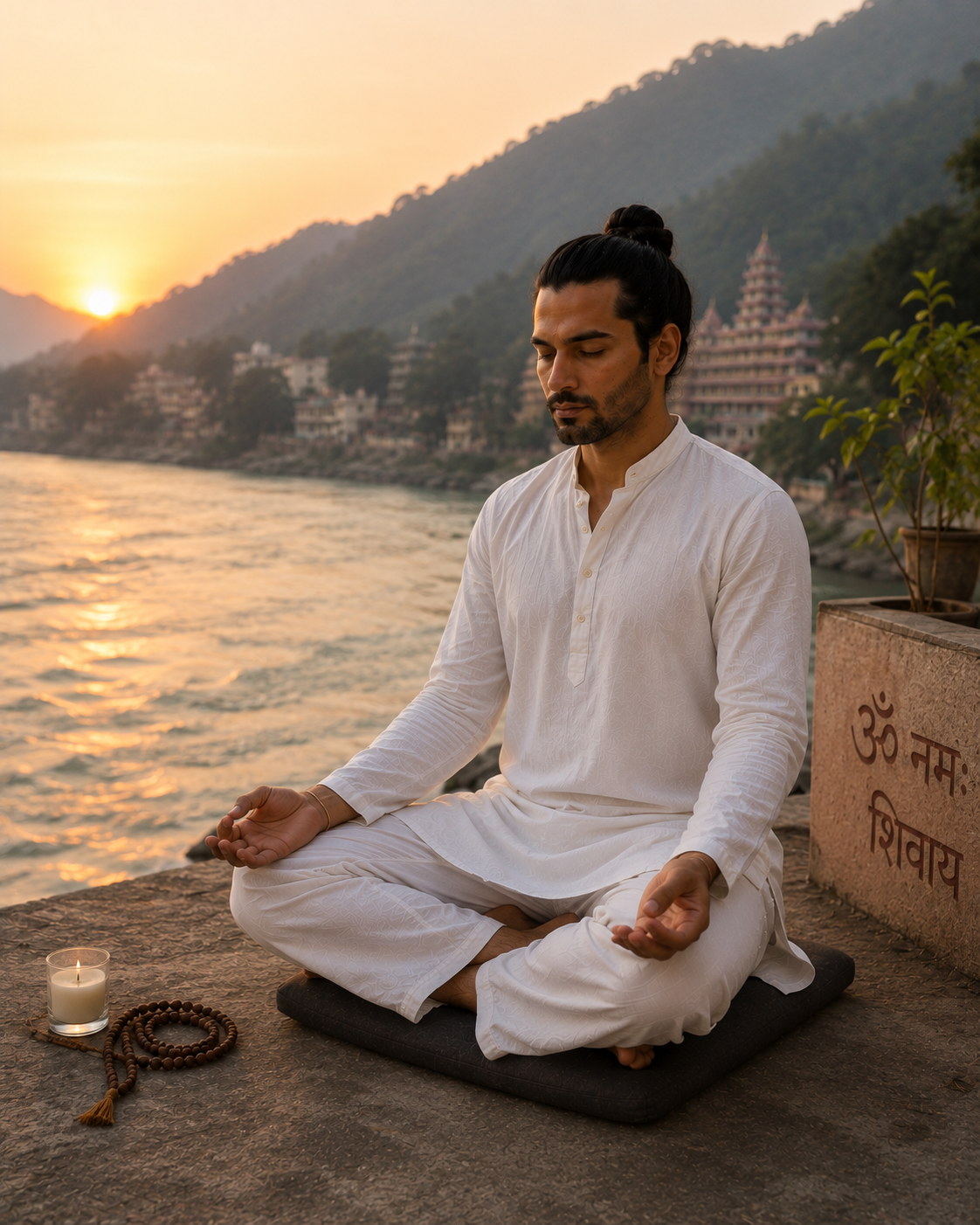
What a meditation retreat offers that a weekly class simply cannot
In a weekly meditation class, you practice for an hour and then return to the ordinary conditions of your life which are typically very demanding of your attention. Whatever settling occurred in the class begins to dissolve within a few hours, as the familiar mental patterns of daily life reassert themselves. The learning from the class is real, but there is not enough time between the challenge of the practice and the pull of ordinary life for the new patterns to become stable.
A meditation retreat changes this completely. Multiple sessions per day, across multiple consecutive days, in an environment where nothing competes for your attention this allows the pattern-building that produces genuine meditative capacity to accumulate without interruption. By day three of consistent sitting, most students notice a quality of stillness that is qualitatively different from anything they have experienced in weekly practice, regardless of how long they have been attending classes.
This quality does not arise because the retreat is special. It arises because the conditions for genuine meditative depth are present: repeated practice, minimal external distraction, skilled guidance, and the particular quietude of Rishikesh a city where contemplative practice is a cultural norm rather than a wellness trend.
Crucially: the purpose of our meditation retreats is not to produce a temporary peak experience that students carry home as a memory. It is to develop a practice robust enough to continue independently after the retreat ends. Everything in the program the instruction, the technique progression, the integration sessions, the guidance on home practice is oriented toward this goal.
The daily program and why each component is there
Multiple Meditation Sessions Daily
Three to four meditation sessions per day, each using a different technique or deepening the same technique at a different time of day. Morning sessions typically use breath-centred or mantra-based practices while the mind is fresh. Afternoon sessions introduce body scan or loving-kindness while the nervous system is in a post-activity rest state. Evening sessions use open awareness or sound-supported meditation as the day closes.
Pranayama Before Meditation
Dedicated breathwork sessions before the primary meditation sittings. The physiological settling produced by pranayama particularly Nadi Shodhana and long deep breathing creates the internal conditions in which meditation becomes significantly more accessible. Students who skip this step and go directly to sitting often find the first twenty minutes of each session spent in the restlessness that the breathwork would have resolved.
Gentle Supportive Yoga
One session of gentle Hatha or Yin yoga each day focused not on physical development but on preparing the body for extended seated practice. This means: opening the hips and inner thighs for comfortable cross-legged sitting, releasing the lower back, mobilising the thoracic spine, and ensuring the neck and shoulders can support an upright seated position without strain for extended periods.
Sound Healing Sessions
At least two Tibetan bowl sound healing sessions across the retreat program typically positioned in the late afternoon, when the body benefits most from deep physiological rest. Sound healing in a meditation retreat serves a specific function: it provides the deepest quality of rest available within the program, allowing the nervous system to integrate the effects of sustained meditation practice without requiring the disciplined attention that sitting practice demands.
Technique Instruction and Q&A
Daily dialogue sessions where participants can discuss their practice experiences with the teacher, ask questions about difficulties they are encountering, and receive specific guidance on how to work with the particular patterns arising in their meditation. This is not lecture content it is direct, responsive instruction. The teacher adjusts their guidance based on what students are actually experiencing, not what the textbook says they should be experiencing.
Integration and Home Practice Planning
The final session of the retreat focuses on integration how to carry what has been developed into daily life. Practical planning for a sustainable home practice: what to practise, for how long, at what time of day, and how to troubleshoot the specific difficulties that arise when the retreat's supportive structure is no longer present. Students leave with a written practice plan, not just an aspiration.
By day four, the sitting that felt like endurance on day one begins to feel like arriving. This is not a metaphor. Something physiologically and neurologically different is happening by day four.
This is what the research supports and what every experienced meditation teacher describes. It requires consecutive practice to produce. A retreat provides consecutive practice.
The students who get the most from a meditation retreat
Complete beginners to meditation
The structure and guidance of a retreat provides a genuinely effective introduction to meditation practice far more effective than attempting to develop a practice through occasional classes or apps. Beginning with a retreat rather than weekly classes means starting with a solid foundation of depth and understanding that then supports independent home practice. Many meditators who have maintained a daily practice for years began with a retreat.
Meditators whose practice has plateaued
Students who have practised for years but feel their meditation is not developing sitting regularly without the sense that anything is changing, or finding that the quality of attention in practice has become mechanical rather than alive. A retreat often reveals why the practice has stalled (typically: technique refinement needed, or depth of practice has been limited by session length) and reestablishes a quality of meditation that the regular practice had not achieved.
People at significant life transitions
The spaciousness and internal clarity that a meditation retreat produces is particularly valuable during major life transitions periods of important decision-making, grief, career change, or personal reinvention. The retreat does not provide answers, but it provides a quality of internal clarity and settled awareness from which answers are significantly more accessible. Many students report that decisions made in the clarity of a meditation retreat felt fundamentally different from decisions made in ordinary, crowded-mind daily life.
Interested in a meditation retreat?
Tell us your experience with meditation, your available dates, and what you are hoping to develop. We will discuss current schedules and find the right program.
Other retreats and programs at The Seventh Center
Explore All Programs & Services
Quickly select any service below to explore schedules, curriculum, and direct WhatsApp booking.
Tell us your experience level and preferred dates. We will find the right fit.
Share your meditation background, your available dates in Rishikesh, and any specific goals. We will discuss current retreat schedules and confirm next steps.