Yoga Style
Vinyasa Yoga When Breath Leads and the Body Follows
Vinyasa yoga links postures through deliberate, breath-synchronised movement creating a continuous, meditative flow in which the transition is as intentional as the destination. Dynamic, intelligent, and adaptable to a wide range of experience levels.
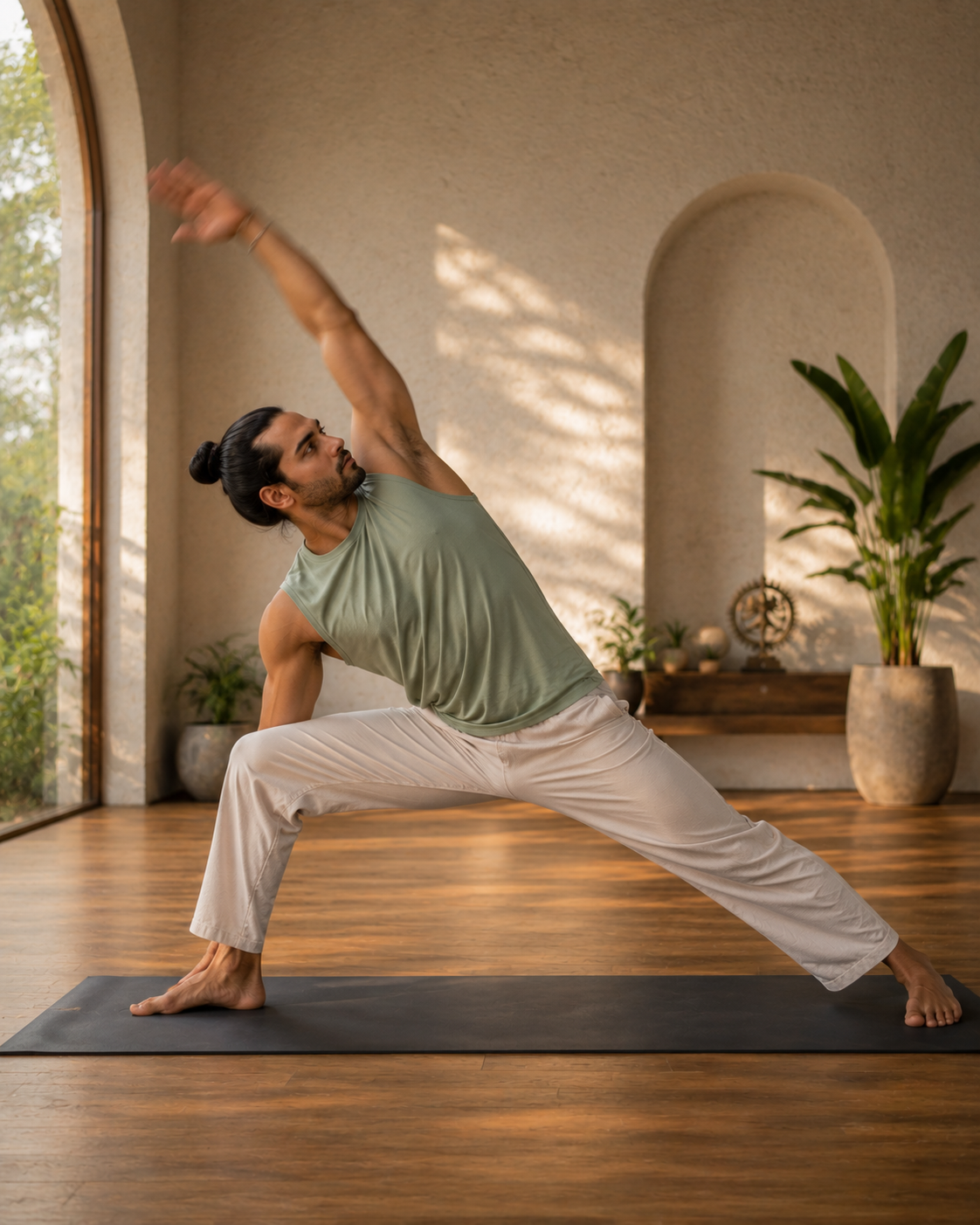
What "Vinyasa" actually means and why it matters
The Sanskrit word vinyasa is composed of vi (in a special way, with intention) and nyasa (to place, to step). It does not simply mean "movement" it means movement with intention, placed carefully, linked to the breath. In the Ashtanga tradition from which modern Vinyasa evolved, the vinyasa was a specific linking sequence (Chaturanga Dandasana Urdhva Mukha Svanasana Adho Mukha Svanasana) used between every posture to maintain energy and heat.
Modern Vinyasa yoga sometimes called Vinyasa Flow takes this linking principle and applies it to creative, non-fixed sequences designed freshly for each class. A Vinyasa teacher builds an arc from opening to peak posture to cool-down, sequencing intelligently so that each posture prepares the body for the next, and so that the accumulation of heat, opening, and focus serves a clear purpose.
The distinction between a well-taught Vinyasa class and a poorly taught one is significant. In the hands of an experienced teacher, Vinyasa is a sophisticated practice in which every transition is as deliberate and aligned as every static posture. In the hands of an inexperienced teacher, it becomes a collection of postures linked by habit rather than intelligence, which produces strain rather than development.
Our Vinyasa classes maintain clear alignment principles even within the flow. Moving fast with poor alignment is an effective way to build poor habits and accumulate micro-injuries. We prioritise clarity over speed.
How a well-taught Vinyasa class is designed
Unlike Ashtanga, which follows a fixed sequence, every Vinyasa class is a composition. Good Vinyasa teaching requires the same skills as intelligent program design knowing what each element is for, and why it comes where it does.
Pranayama and intention setting
A brief, focused opening usually five to eight minutes of breath awareness, Ujjayi training (for those newer to it), and a clear statement of the session's focus (for example: hip opening, backbends, arm balances, or a specific theme). The opening tells the body and mind what direction they are heading.
Sun Salutations and preparatory sequences
Multiple rounds of Surya Namaskar A and B, modified to build heat progressively. As the body warms, variations are added low lunge, twisted lunge, standing splits that prepare specific joints and muscle groups for the peak postures to come. The warm-up flow should already feel intentional, not just generic movement.
Building to the session's peak
A flowing sequence of standing postures that progressively opens the required areas and builds the specific strength for the session's peak. In a hip-focused class, this might be a sequence building from Warrior II through Trikonasana to Ardha Chandrasana. In a backbend-focused class, it might build through standing backbends toward Wheel. The teacher chooses every posture based on what the sequence needs, not on what is impressive to watch.
The session's central challenge
The posture or posture group that the whole class has been building toward. Arm balances (Bakasana, Eka Pada Koundinyasana), deep backbends (Urdhva Dhanurasana, Kapotasana), inversions (Headstand, Pincha Mayurasana), or advanced hip openers. Students who are not ready for the peak posture work in an appropriate preparation a good Vinyasa teacher ensures no one in the room is watching others while waiting for the class to move on.
Intelligent reversal of the peak's demands
Every peak posture creates a demand backbends compress the posterior spine and hip flexors; deep hip openers create muscular imbalances in the pelvis; inversions require specific shoulder engagement that needs releasing afterward. Good Vinyasa teaching includes deliberate counter-poses that address these demands, leaving the body in better balance than it started.
Integration and savasana
Seated postures, supine stretches, and 10�12 minutes of Savasana. The floor work allows the elevated heart rate to return to baseline progressively rather than abruptly, and provides a transition from dynamic to still that the nervous system needs after vigorous practice. Savasana is held fully not shortened because time ran over.
The specific physical and mental qualities that Vinyasa yoga builds
Cardiovascular fitness and endurance
A full Vinyasa class maintains an elevated heart rate throughout, through the continuous movement and heat generated by the vinyasas. This produces genuine cardiovascular conditioning not incidentally, but as a core feature of the practice. Students who practise Vinyasa three or more times a week typically notice changes in overall endurance and cardiovascular efficiency within two to three months.
Full-body functional strength
Chaturanga Dandasana, performed properly as a full elbow-angle lowering from plank, is one of the most demanding upper-body exercises in yoga. In a Vinyasa class with many transitions, students perform this movement dozens of times, building shoulder, arm, and core strength systematically. Combined with the leg and hip demands of standing postures, Vinyasa develops balanced full-body functional strength.
Coordination between breath and movement
The fundamental discipline of Vinyasa every movement linked to a specific breath trains a quality of psycho-physical coordination that extends well beyond the yoga mat. Students who practise Vinyasa consistently develop a body-breath relationship that changes how they move in all activities: running, swimming, cycling, even everyday physical tasks become more efficient as the habit of conscious breath-movement integration develops.
Concentration under physical demand
Maintaining focused attention while the body is working hard is a specific skill that Vinyasa trains. The combination of physical challenge and the requirement to keep tracking the breath and the next movement leaves no space for the distracted thinking that most people's minds habitually pursue. This "flow state" quality complete absorption in a challenging activity is one of the primary reasons students report that Vinyasa functions as a stress release in a way that sedentary meditation initially does not.
Fluency in a wider range of postures
Because Vinyasa sequences change each session, students are exposed to a broader range of postures than any fixed sequence provides. Over time, this builds familiarity with posture families backbends, arm balances, inversions, deep hip openers that produces genuine fluency. Students know not just how to enter each posture but how to transition into it from a range of approaches, which is a different and more complete kind of knowledge.
Adaptability in how you think about practice
Unlike the fixed-sequence discipline of Ashtanga, Vinyasa yoga requires adapting to whatever the teacher has designed for this session. Over time, this builds a kind of physical intelligence the capacity to encounter an unfamiliar sequence and find your way through it with competence. This adaptability is one reason many yoga teachers train in Vinyasa: because understanding how sequences are intelligently built is itself a teacher training in miniature.
The difference between a yoga class with movement and a Vinyasa practice is this: in one, you are doing poses. In the other, the breath is moving you.
This distinction breath as initiator rather than accompaniment is what separates genuine Vinyasa from movement practice that happens to include yoga shapes.
The students who tend to get the most from Vinyasa yoga
Students with a yoga foundation already in place
Students who have practised Hatha yoga for three months or more, or who have prior experience with another yoga style, typically find Vinyasa immediately rewarding. The postures themselves are familiar enough that attention can go to the linking and the breath rather than to working out what each posture is. This is the primary prerequisite not athletic ability, but basic yoga familiarity.
People who benefit from movement-based stress release
Some people sit still and their mind quiets. Others need the demand of physical effort to achieve the same result the body working hard enough that the habitual thought-loops of daily stress simply cannot compete for attention. Vinyasa serves this population exceptionally well. It is a legitimate and complete practice in itself, not a lesser alternative to meditation-based approaches.
Athletes and active people seeking a complementary practice
Runners, cyclists, climbers, swimmers, and other athletes who practise Vinyasa consistently report improved range of motion, reduced injury frequency, and a quality of body awareness that improves their primary sport. The combination of strength, flexibility, and breath training in Vinyasa makes it an unusually effective complement to almost any athletic activity.
Interested in Vinyasa yoga classes?
Tell us your yoga background and preferred format online or in Rishikesh. We will recommend the right class level.
Common questions about Vinyasa yoga
Vinyasa is better suited to students with some prior yoga experience ideally three to six months of Hatha yoga. The pace of a Vinyasa class does not allow enough time for detailed alignment explanation with each posture, which means beginners often end up going through motions they do not understand, which builds poor movement patterns. We recommend starting with Hatha yoga first then transitioning to Vinyasa once the basic posture vocabulary and breath awareness are established. This path produces better results in less time than beginning directly with Vinyasa.
"Power yoga" is a marketing term that emerged in the 1990s (largely through teachers Bryan Kest and Beryl Bender Birch) to describe a vigorous, athletic adaptation of Ashtanga and Vinyasa for Western fitness audiences. It de-emphasised Sanskrit naming, spiritual context, and philosophical content in favour of physical intensity. Modern usage of the terms has blurred significantly many classes marketed as "Power yoga" are essentially vigorous Vinyasa, and many "Vinyasa" classes are quite intense. The meaningful distinction is not the label but the quality of teaching: does the teacher understand intelligent sequencing, does the breath lead the movement, and is alignment maintained within the flow?
Several indicators: The class has a clear arc it builds toward something and then comes back down. The teacher explains why postures come in the order they do, not just what to do. Modifications are offered proactively, not as an afterthought. Alignment cues continue throughout the flow, not just in static holds. The vinyasas themselves are cued as precisely as the postures they link. Savasana is given proper time. The teacher watches students and adjusts their instruction based on what they see not delivering a pre-scripted performance regardless of the group. If a teacher barely looks at the students, the class is a performance, not teaching.
Yes, and many students develop their own home practice over time. Unlike Ashtanga, where the fixed sequence makes home practice straightforward, Vinyasa home practice requires either following along with recorded classes or developing enough sequencing knowledge to design your own sessions. We support students in building this capacity understanding not just what postures exist but how to arrange them into an intelligent, safe sequence that works for their own body on a given day. This sequencing knowledge is part of what we teach in our broader yoga education.
Pause. Come to Child's Pose (Balasana) and re-establish your breath before rejoining the class. This is not a failure or an interruption it is the correct response when the breath becomes forced or disappears. Practising yoga without breath is simply exercise. The breath is what makes it yoga. In a well-taught Vinyasa class, taking a child's pose to breathe will be actively encouraged by the teacher, not ignored or discouraged. If you are consistently losing the breath in a class, this is information: the class may be pitched at a level above your current capacity, or you may need to reduce the scope of individual postures to keep them within your breath's range.
Other yoga styles and programs to explore
Explore All Programs & Services
Quickly select any service below to explore schedules, curriculum, and direct WhatsApp booking.
Join a Vinyasa class online or in Rishikesh.
Tell us your yoga background and what you are looking for. We will match you to the right class level and schedule a time that works.