Yoga Style
Ashtanga Yoga Structure, Discipline, and the Power of Repetition
Ashtanga yoga follows a fixed sequence of postures, linked by breath and deliberate movement. Physically demanding, internally focused, and built on consistent daily practice it is one of the most systematised and studied yoga traditions in the world.
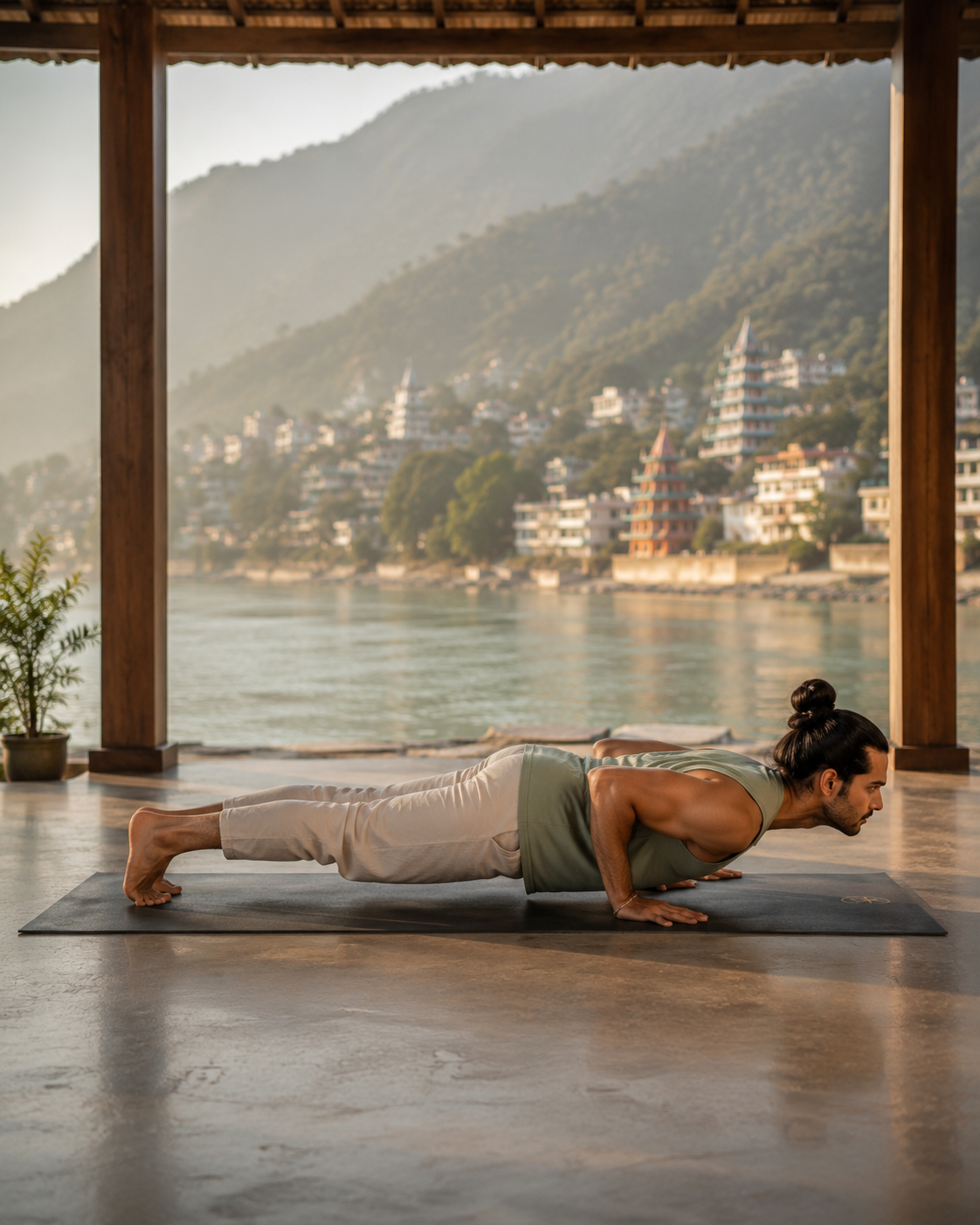
Where Ashtanga comes from and why its structure matters
Ashtanga yoga as a physical system was systematised by Sri Krishna Pattabhi Jois (1915�2009) at the Ashtanga Yoga Research Institute in Mysore, Karnataka, India which is why Ashtanga is still commonly called "Mysore yoga" in many countries. Jois based the system on the teachings of his guru, T. Krishnamacharya, and on a manuscript called the Yoga Korunta, attributed to the sage Vamana Rishi, which Krishnamacharya is said to have studied.
The Ashtanga system is organised into six series of increasing difficulty. The vast majority of practitioners including those who have practised for many years work with the Primary Series (Yoga Chikitsa) and may begin exploring the Intermediate Series (Nadi Shodhana). The Advanced Series A, B, C, and D are practised by very few students worldwide and require decades of dedicated daily practice.
The word "Ashtanga" means eight limbs the eight-fold path described by Patanjali in the Yoga Sutras: Yama, Niyama, Asana, Pranayama, Pratyahara, Dharana, Dhyana, and Samadhi. The physical Ashtanga practice as taught by Jois uses asana as the primary vehicle, but it is understood as part of this broader framework, not as a standalone athletic practice.
What makes Ashtanga distinctive is its relationship to repetition. The same sequence is practised every day (traditionally six days a week, with rest on Saturdays and moon days). This repetition is not monotony it is how depth is built. A posture practised once a week for a year produces different results than the same posture practised six times a week. The body and mind adapt differently when challenged with consistent, progressive frequency.
Tristhana the three points of focus that define Ashtanga practice
The defining technical feature of Ashtanga yoga is Tristhana: the simultaneous focus on three elements during every posture. This is what produces the deeply concentrated, meditative quality that practitioners describe.
The posture alignment and stability
Each posture in the Ashtanga sequence is held for five breaths (in led class) or for as long as feels appropriate in Mysore style. The alignment principles are specific and consistent not aesthetic guidelines but structural requirements for safely loading the body in each shape. New postures are only introduced when the preceding ones demonstrate sufficient stability.
The gaze where the eyes look and why
Each posture has a designated gaze point (drishti): nasagrai (tip of the nose), ajna chakra (third eye), nabhi (navel), padhayoragrai (toes), hastagrai (hand), parsva (to the side), urdva (upward), or angusta (thumb). Fixing the gaze in a specific place supports concentration by reducing external visual distraction, and physically supports alignment by directing the orientation of the head and therefore the spine.
The breath and internal locks
Ujjayi pranayama a slow, audible breath created by slightly constricting the throat is maintained throughout the entire Ashtanga practice. Combined with Mula Bandha (perineal lock) and Uddiyana Bandha (lower abdominal engagement), it generates internal heat, supports the spine, and creates the distinctive internal focus that distinguishes Ashtanga from more externally oriented yoga styles.
Yoga Chikitsa the First Series explained
The Primary Series (Yoga Chikitsa, meaning "yoga therapy") consists of approximately 41 postures practised in a fixed sequence, each linked to the next by a vinyasa (a specific transitional movement involving Chaturanga Dandasana a low plank Urdhva Mukha Svanasana upward dog and Adho Mukha Svanasana downward dog). It begins with Sun Salutations A and B, moves through standing postures, then a long series of seated postures, finishes with a closing sequence of inversions and backbends.
Sun Salutations the opening of every practice
Five repetitions of Surya Namaskar A and three of Surya Namaskar B begin every Ashtanga practice. They are not a warm-up to be abbreviated they are themselves a complete practice sequence that generates internal heat, synchronises breath with movement, and establishes the Ujjayi breath and bandha engagement that will be maintained throughout.
Standing postures strength, stability, and ground
The standing sequence of the Primary Series includes Padangusthasana, Padahastasana, Trikonasana, Parivrtta Trikonasana, Utthita Parsvakonasana, Prasarita Padottanasana (four variations), Parsvottanasana, Utthita Hasta Padangusthasana, Ardha Baddha Padmottanasana, Utkatasana, and Virabhadrasana. Each has a specific vinyasa count and drishti. The standing sequence builds the foundation of leg strength and hip mobility for the seated postures that follow.
Seated postures the systematic opening of the body
The seated sequence which forms the majority of the Primary Series moves methodically through forward folds (Dandasana through Supta Konasana), hip openers (Baddha Konasana, Upavistha Konasana), and finishing with Marichyasana A, B, C, D, Navasana, Bhujapidasana, Kurmasana, Supta Kurmasana, Garbha Pindasana, and Kukkutasana. The sequence is specifically designed to open the hamstrings, hip flexors, and external rotators in a graduated way that prepares the body for deeper postures introduced only when earlier ones are stable.
The finishing sequence inversions and deep rest
Every Ashtanga practice ends with the same closing sequence: Setu Bandhasana (bridge), Urdhva Dhanurasana (wheel, optional), Sarvangasana (shoulderstand), Halasana (plough), Karnapidasana, Urdhva Padmasana, Pindasana, Matsyasana, Uttana Padasana, Sirsasana (headstand), Balasana, and Padmasana in savasana. The closing sequence is not negotiable it is the integration component that makes the preceding practice produce lasting effects.
Mysore-style versus led Ashtanga classes what the difference means in practice
Mysore-style practice the traditional format
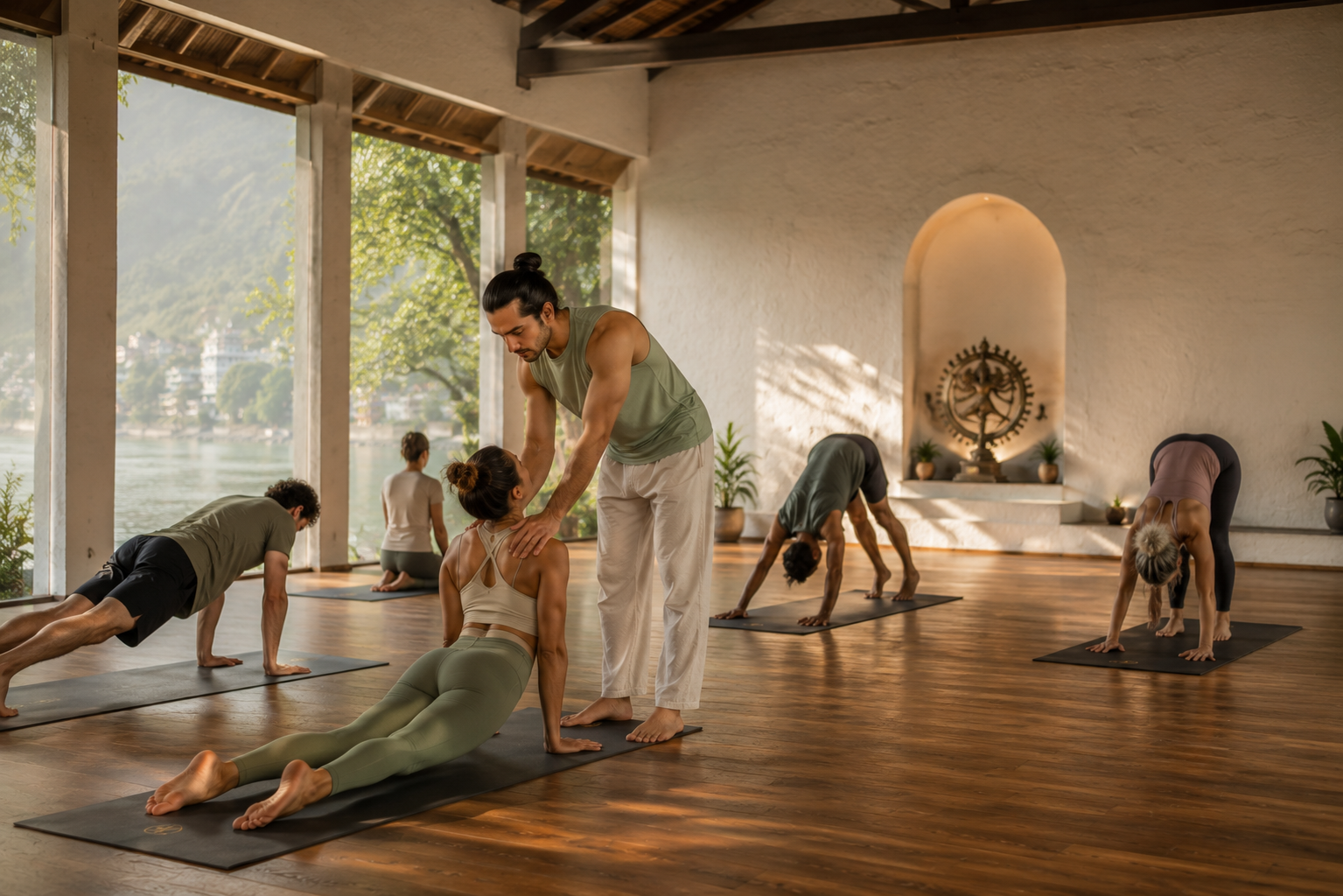
In Mysore style, students arrive and begin practicing the sequence independently, at their own pace. There is no group countdown or teacher leading everyone simultaneously. The teacher circulates through the room, offering individual physical assists, verbal corrections, alignment adjustments, and most importantly introducing new postures when a student demonstrates sufficient stability in those already learned.
This format produces profound results because the practice is genuinely personalised. A student who needs more time in Baddha Konasana takes more time. A student ready for Navasana is ready for it when they are ready for it not when the class arrives there. The teacher's role is not to perform in front of the group but to serve each student's individual practice.
Suitable for: Students who have learned the sequence, and for beginners working progressively through it with individual teacher guidance.
Led class the counting method
In a led class, the teacher counts the entire sequence in Sanskrit calling each posture and each vinyasa count, so the whole group moves together. This format develops consistency of pace, prevents the habit of lingering too long in comfortable postures and rushing through challenging ones, and provides the experience of practising within the exact traditional timing of the sequence.
Led classes are used in traditional Ashtanga teaching as a supplement to Mysore practice typically twice a week in some schools, while the other days are Mysore style. For students new to the sequence, led classes can also serve as an introduction to the order and pace of postures before attempting self-practice in Mysore style.
Suitable for: Students with an existing knowledge of the sequence who want to practise with consistent timing and group energy.
"Do your practice and all is coming."
Sri K. Pattabhi Jois often cited and often misunderstood. What it means: not that everything will be given to you, but that consistency of practice creates the conditions from which everything meaningful in yoga arises.
What serious Ashtanga practice develops over months and years
Extraordinary functional strength
The repeated vinyasas Chaturanga Dandasana performed dozens of times in a full Primary Series practice build shoulder, arm, and core strength that most other yoga styles simply do not demand. After six months of consistent Ashtanga practice, students' upper body strength typically transforms visibly. This is not cosmetic development it is functional strength that translates to everything else the body does.
Hip and hamstring opening
The Primary Series is specifically designed as "yoga therapy" a systematic opening of the hamstrings, hip flexors, external rotators, and adductors through the seated sequence. Students who have been trying to touch their toes for years without success often achieve it within their first six months of consistent Ashtanga practice, because the frequency and methodical progression of the sequence produce changes that occasional yoga classes simply cannot.
Moving meditation
This is the quality that keeps serious practitioners returning for decades. The combination of Tristhana fixed sequence, drishti, and Ujjayi breath creates a state of internal absorption that practitioners describe as genuinely meditative. Because the sequence is known and practised the same way each day, the mind is not occupied with "what comes next?" and can instead remain present in the direct experience of the practice. The fixed sequence, which sounds monotonous from the outside, produces this profound internal focus from the inside.
Discipline as a transferable quality
There is something that regular Ashtanga practitioners develop that goes beyond physical ability a quality of discipline and commitment that carries into other areas of life. Rising early to practise, maintaining consistency through periods when the practice is uncomfortable, working with a challenging posture for months without forcing it these build a quality of sustained effort and patience that is increasingly rare and genuinely valuable.
Cardiovascular conditioning
A full Primary Series practice, typically taking 60 to 90 minutes, maintains an elevated heart rate throughout due to the repeated vinyasas and internal heat generated by Ujjayi breath and bandha. This cardiovascular component is not incidental it is why Ashtanga produces the distinctive combination of strength, flexibility, and endurance that practitioners have. There is no equivalent in yoga that works these three qualities simultaneously with this degree of integration.
Depth in individual postures over years
Because you practise the same postures day after day, depth in each individual posture develops at a rate impossible in classes where the sequence changes every session. A posture practised six times a week reveals layers that a posture practised once a week simply cannot. Practitioners report that postures they thought they "had" after a year continue to reveal new dimensions five years later. This is the specific gift of a fixed sequence system.
Interested in Ashtanga yoga?
Tell us your current yoga experience. We will advise honestly whether Ashtanga is the right next step or whether a different starting point makes more sense for you now.
What students ask about Ashtanga yoga
Ashtanga is not the ideal starting point for most beginners. The sequence is physically demanding and assumes a working familiarity with common postures, Ujjayi breathing, and basic body awareness that beginners typically have not yet developed. We recommend starting with Hatha yoga for at least three to six months first this builds the foundation that allows Ashtanga to be practised safely and productively. Some students with strong athletic or physical backgrounds can begin Ashtanga sooner; it depends on the individual. Tell us about your situation and we will give you an honest assessment.
Traditionally, Ashtanga is practised six days a week (rest on Saturdays and moon days). This frequency is what produces the specific results physical, mental, and energetic that distinguish serious Ashtanga practitioners. In practice, most modern students practise three to five times a week, which still produces significant development. Two sessions a week will produce some change but will not generate the depth that makes Ashtanga distinctive. If your schedule only allows two days a week, Hatha or Vinyasa may be a more productive investment than Ashtanga.
No. Ashtanga yoga is practised by people across a wide age range practitioners in their 50s, 60s, and beyond maintain serious practices. The practice adapts to the individual through the Mysore format: you progress at your own pace and within your own current capacity. What changes with age is not the suitability of the practice but the rate of progression and the importance of adequate rest between sessions. Pattabhi Jois himself practised and taught until very shortly before his death at 93. That said, Ashtanga is physically demanding, and students with significant injuries or health conditions should discuss their situation with us before beginning.
Modern Vinyasa yoga grew directly out of the Ashtanga system. The "vinyasa" the specific linking movement between postures was adapted and liberalised by teachers who had trained in the Ashtanga tradition. Where Ashtanga uses a fixed, invariable sequence, Vinyasa teachers create new sequences for each class. This makes Vinyasa more varied and accessible, but it also means it cannot produce the depth of posture-specific development that repetition creates in Ashtanga. Students who practise both often describe Ashtanga as producing greater depth and Vinyasa as providing greater breadth.
Moon days are the days of the full and new moon, observed as rest days in the traditional Ashtanga calendar alongside Saturdays. The classical explanation is that the gravitational pull of the moon affects the water in the human body (as it affects the tides), making these days less suitable for vigorous physical practice. The practical explanation is perhaps simpler: in a daily practice, built-in rest days are essential they prevent the accumulation of fatigue that leads to injury and allow the body to fully integrate the effects of the preceding practice. Whether or not you accept the lunar explanation, the principle of structured rest within a demanding daily practice is physiologically sound.
Learning the complete Primary Series and being able to practise it independently typically takes one to two years of consistent Mysore-style practice, for a student practising four or more times a week. The timeline varies enormously based on individual body structure, prior athletic background, practice frequency, and the quality of instruction. More importantly: learning the sequence is not the goal. The goal is the depth of practice that develops through consistent engagement with the sequence over time. Some very experienced practitioners have said that the Primary Series took them their entire careers to fully understand. This is not a discouragement it is an honest picture of what a serious physical discipline looks like.
Other styles and programs at The Seventh Center
Explore All Programs & Services
Quickly select any service below to explore schedules, curriculum, and direct WhatsApp booking.
Ready to explore Ashtanga? Tell us where you are first.
Share your current practice and experience level. We will be honest with you about whether Ashtanga is the right next step, or whether another path makes more sense right now.