Yoga Style
Yin Yoga Stillness as Practice, Depth Without Force
Yin yoga is not passive in the sense of being effortless. It is passive in the sense of being non-muscular the body is held still in positions that gradually stress the connective tissue rather than the muscles. It is one of the most sophisticated and deeply misunderstood yoga styles.
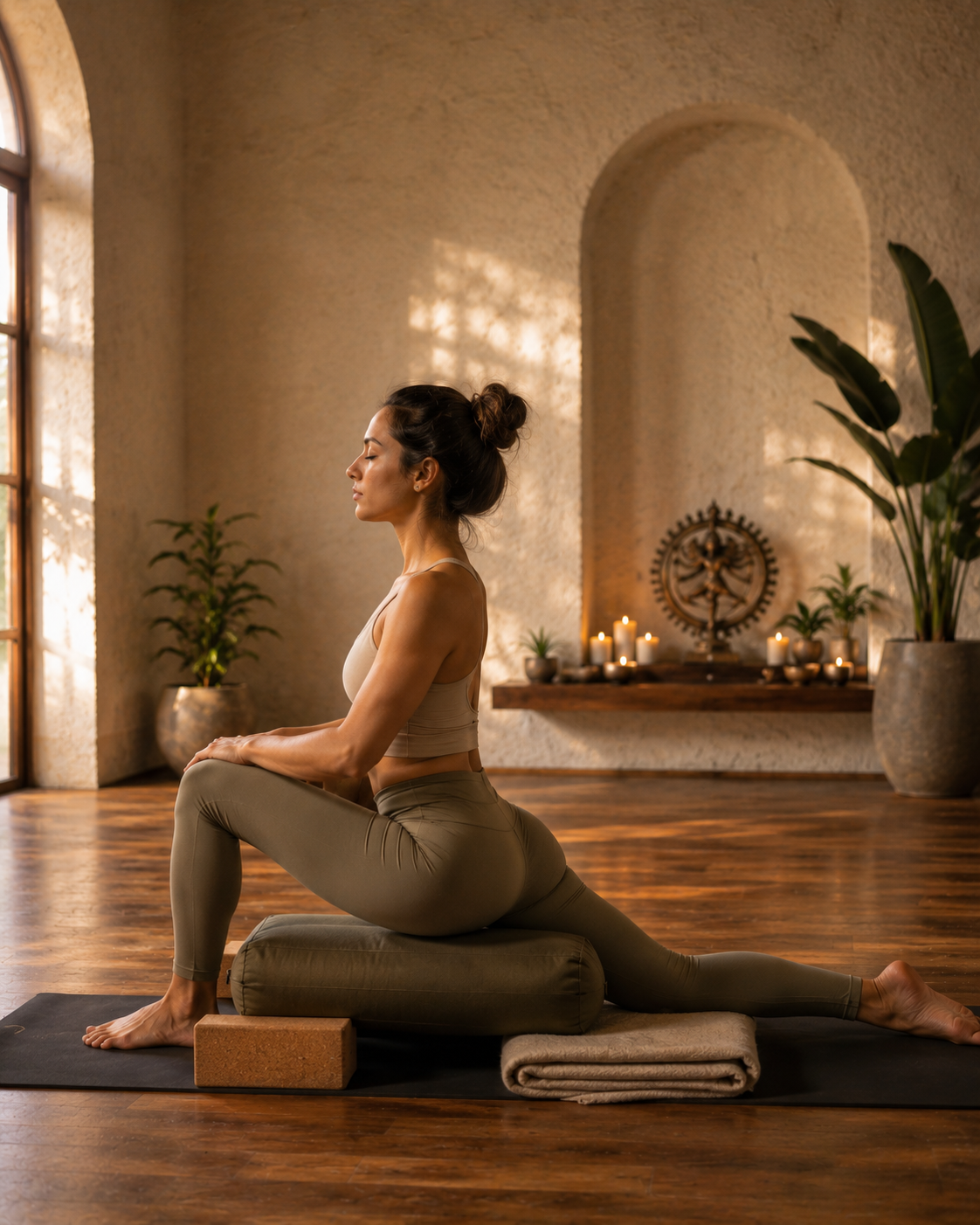
Why Yin yoga works differently from every other yoga style
Every yoga style you know Hatha, Vinyasa, Ashtanga primarily addresses the muscular tissue of the body. Muscles respond well to dynamic stretching and active engagement: they warm up, they lengthen, they strengthen. Yin yoga targets something different: the connective tissue fascia, ligaments, joint capsules, and tendons which has an entirely different physiological response to stress.
Connective tissue does not respond to brief, dynamic stress it responds to sustained, gentle, cool stress. When you hold a position for three to five minutes with the muscles deliberately released, you begin to apply a stimulus that the connective tissue can actually respond to. This process called plastic deformation or creep in biomechanics allows the connective tissue to gradually lengthen and remodel, producing changes in joint range of motion that are typically more durable than those achieved through active stretching.
This is why athletes who train vigorously and practise active yoga regularly can still find Yin yoga revealing their muscles may be strong and flexible, but their connective tissue has received little specific stimulus. A marathon runner who takes a Yin class for the first time typically finds sensations in the hips and inner thighs that no amount of post-run stretching has previously reached.
The tradition of Yin yoga was developed by Paul Grilley in the 1980s, drawing on the work of Paulie Zink and on insights from the Chinese Taoist tradition particularly the meridian system of Traditional Chinese Medicine, which understands the body's connective tissue network as a pathway for the circulation of qi (vital energy). Sarah Powers further developed the practice in the 1990s. While the TCM framework is not scientifically verified, it provides a useful map for understanding which postures target which areas and in what sequence.
What distinguishes Yin yoga from simply lying in a stretch
Paul Grilley identified three principles that must be present for a posture to function as Yin yoga rather than passive stretching. Understanding these changes how you experience the practice.
Come to an appropriate edge
The "edge" in Yin is the point of sensation in the target area typically a dull, diffuse feeling of stretch or mild compression in the joints. Not pain, not the absence of all sensation. Too shallow and the connective tissue receives no meaningful stimulus. Too deep and the protective reflex in the muscles activates, or in hypermobile individuals joint structures are overloaded. Finding the appropriate edge is a skill that develops with practice and good teacher guidance.
Be still
Once at the edge, stop moving. Fidgeting, micro-adjusting, and shifting around all return the tissue to its natural length before plastic deformation can begin. Stillness is the mechanism not relaxation, not breath, not intention. The body has to actually stay in one place for several minutes for the connective tissue to respond. This is the most difficult aspect of Yin for many students, particularly those accustomed to dynamic practice.
Hold for time
Connective tissue requires time to respond to sustained stress typically three to five minutes minimum for fascia and ligaments to begin the creep response. Some advanced practitioners hold Yin postures for ten minutes or more. The time requirement is not negotiable: thirty seconds in a Yin posture produces a muscular stretch. Three to five minutes begins to address the connective tissue. This is why Yin classes feel slow and why that slowness is not a deficit but the mechanism of the practice.
The main Yin postures what they work and why
Dragon (Low Lunge Variations) hip flexors and groin
Dragon and its variations target the hip flexors (psoas, iliacus, rectus femoris) and the hip joint capsule. These tissues are chronically shortened in people who sit for extended periods and are rarely adequately addressed in active yoga. Dragon held for three to five minutes creates a sustained stimulus to the hip flexors and quadriceps that running, cycling, and active yoga classes simply cannot replicate. Many people experience Dragon as among the most uncomfortable Yin postures which typically indicates how much their hip flexors needed it.
Butterfly (Baddha Konasana) inner thighs and lumbar spine
Sitting with the soles of the feet together and folding forward, Butterfly targets the inner thighs (adductors), the sacrum, and the lumbar spine. Unlike the active version in Hatha yoga, the Yin version uses gravity rather than muscular effort to create the forward fold. Held for three to five minutes, it produces a sustained stimulus to the adductor connective tissue and the lumbar spinal ligaments that is qualitatively different from active versions of the same shape.
Caterpillar (Seated Forward Fold) spine and hamstrings
In Yin, the seated forward fold becomes a spinal posture rather than a hamstring stretch. The intention is to decompress the posterior spine with the legs extended and the spine allowed to round naturally not to reach as far forward as possible. This creates traction in the posterior spinal ligaments, the inter-vertebral discs, and the thoracolumbar fascia. For people with disc bulges (always discuss with your doctor), the traction created in Caterpillar can be significant; always disclose back conditions to your teacher.
Shoelace / Square (Figure-Four) hip external rotators
Targets the external rotators of the hip piriformis, obturators, gemelli which are the group responsible for the sensation many people describe as "piriformis syndrome" or a deep ache in the outer hip and gluteal region. These muscles are dense and largely unresponsive to brief active stretching. The sustained stress of a Yin posture held for four to five minutes creates a level of stimulus that can address chronic tightness in this area that years of active yoga has not.
Snail / Plough (Spinal Flexion) thoracic spine and posterior neck
A supine posture in which the legs are brought over the head, creating strong flexion through the thoracic spine and cervical spine. Targets the supraspinous and interspinous ligaments of the thoracic vertebrae, and the posterior cervical connective tissue. Contraindicated for students with cervical disc issues or any neck condition always disclose before class. For appropriate students, it creates a quality of spinal decompression that most people have never experienced.
Staying with a posture for five minutes while the mind wants to leave is, for many people, one of the most genuinely difficult things they do in any given week and the most useful.
The discipline of non-movement is different from the discipline of movement. Both are real practices. Both deserve serious attention.
The students who tend to get the most from Yin yoga
Athletes and vigorous yoga practitioners
People who train intensively in any physical discipline running, cycling, strength training, Ashtanga yoga, Vinyasa typically develop strong, flexible muscles but chronically tight connective tissue. The vigorous training that builds their athletic capacity also produces accumulated fascial tension that active recovery does not adequately address. Yin yoga is the specific modality that accesses this tissue layer. One Yin class a week as a complement to intensive training produces changes that additional active sessions do not.
People who struggle with stillness and meditation
Many people find sitting meditation almost impossible at the beginning the body is restless, the mind follows the body. Yin yoga provides a structure for stillness that the body cannot easily escape: you are in a posture, the posture requires you to stay, and the sensations that arise provide an immediate and unavoidable object of attention. Many students discover their capacity for meditation through Yin practice first, and then find that seated meditation becomes more accessible once the habit of returning attention to present sensation has been established.
People with chronic tension in hips, lower back, or shoulders
The areas where people carry the most persistent physical tension the hip complex, the lumbar spine, the shoulder girdle are largely composed of connective tissue, and respond poorly to the brief active stretching that most people attempt. If you have been stretching regularly without seeing change in these areas, Yin yoga's sustained, passive approach to the same tissues often produces results that have been absent from years of active stretching. The change is typically slow to appear but, once established, more durable than muscular flexibility.
Ready to try Yin yoga?
Yin is accessible for all levels. Contact us to discuss format online or in Rishikesh and current class schedules.
What students ask before their first Yin class
They are related but not the same. Restorative yoga uses props (bolsters, blankets, blocks, eye pillows) to fully support the body in positions where there is zero sensation the nervous system can rest completely. The purpose is recovery and parasympathetic nervous system activation. Yin yoga also uses some props, but it deliberately works at the edge of mild sensation enough to stimulate the connective tissue. There is something to feel in Yin. Yin is therapeutic but not purely resting. Both are valuable, and for different purposes.
Two reasons. First: in Yin, the muscles are intentionally relaxed, so you are feeling the connective tissue which has more nerve endings related to deep sensation and proprioception than muscular tissue does. Second: the sensations arise gradually as the tissue creeps into a new position, and continue to build during the hold. In active yoga, sensation remains relatively constant once the posture is established. In Yin, what starts as mild sensation often intensifies over two to three minutes as the tissue responds. This is normal, expected, and the mechanism of the practice as long as the sensation remains dull and diffuse rather than sharp and specific (which would indicate nerve or joint involvement and would require adjustment).
Appropriate Yin sensation: dull, diffuse, spreading sensation in the belly of the tissue being targeted. Mild compression in a joint. Gradual intensification over the first two minutes. These are working signals stay with them, breathe into them. Signals to adjust: sharp, specific pain anywhere. Pins and needles or numbness. Pain that feels located in a joint rather than in the surrounding tissue. Pain in the lower back or neck that is not a diffuse stretch. Any electrical or burning sensation. These are protective signals reduce the depth of the posture, use more props, or come out entirely. A good teacher walks the room and checks in; tell them if you experience any of these.
One to two Yin sessions per week is typically enough to produce consistent development in joint range of motion and connective tissue health for most people. Unlike muscular training, connective tissue requires more recovery time between sessions because the remodelling process is slower. Practising Yin daily is generally too much. As a complement to active practice one Yin class per week alongside three or four active yoga or training sessions it tends to produce the best overall outcomes. Yin is best practised in the evening or after active training, when the body is warm and the nervous system is ready to downregulate.
With appropriate modifications, yes but Yin yoga requires more careful adaptation for students with osteoporosis than most active yoga styles. The key concern is avoiding spinal flexion under compression loads, which can increase fracture risk in vertebrae with reduced density. Many classic Yin poses (particularly forward folds and any posture involving spinal rounding) need to be either avoided or modified significantly. We always ask about bone density conditions before placing students in classes and can recommend appropriate modifications. Students with diagnosed osteoporosis should discuss which specific postures are appropriate with their doctor before any yoga practice.
Practices that pair naturally with Yin yoga
Explore All Programs & Services
Quickly select any service below to explore schedules, curriculum, and direct WhatsApp booking.
Enquire about Yin yoga classes online or in Rishikesh.
Yin is accessible to all levels and experience backgrounds. Tell us what you are looking for and we will discuss format and schedule.