Retreats in Rishikesh
Yoga Retreats in Rishikesh A Concentrated Practice Experience That Changes What You Take Home
Multi-day yoga retreats in Rishikesh. Daily morning and evening practice, meditation, pranayama, and genuine time to integrate. Designed as a serious practice experience not a wellness holiday for students who want to understand what intensive daily yoga actually produces.
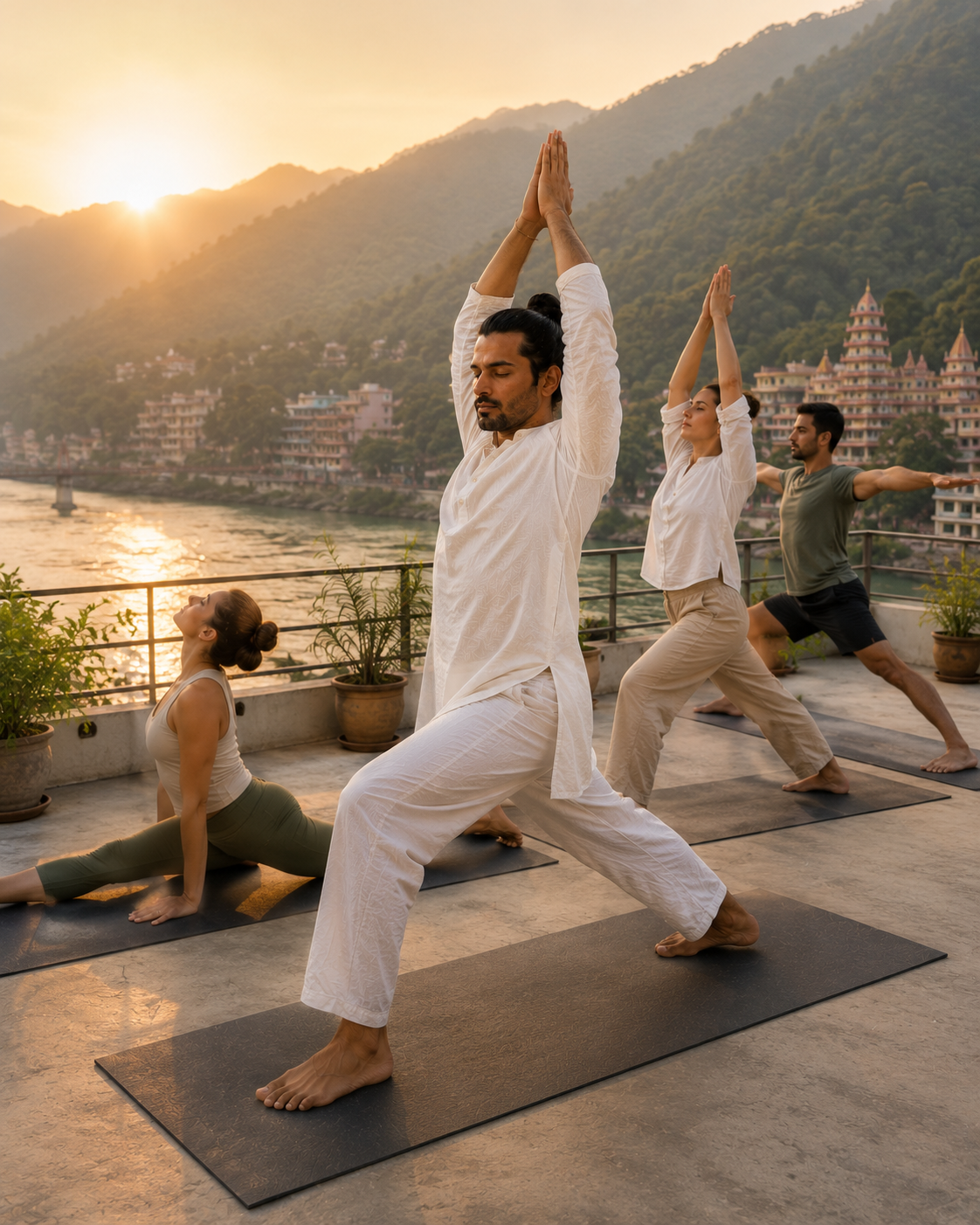
What intensive daily practice actually produces and why it is qualitatively different from weekly classes
Regular weekly yoga classes two or three sessions a week produce real development. The body adapts, the practice deepens, and over months and years, students notice significant change. But this development has a characteristic shape: gradual, cumulative, sometimes stalling, often non-linear. Each session builds on the last, but there are large gaps in between during which the nervous system returns to its habitual patterns before being asked to shift again.
A retreat changes this dynamic fundamentally. When practice is daily and supported by an environment where the primary purpose of every element of the day is to support that practice something different becomes possible. The nervous system does not return to its habitual baseline between sessions. Development accumulates without interruption. By day three or four of a consistent retreat, most students notice a quality of presence, physical openness, and mental clarity that simply is not available through weekly practice, regardless of how many years they have attended classes.
The Rishikesh environment amplifies this. Early morning practice on the banks of the Ganges, surrounded by others who have arrived specifically to practise seriously, in a place with an unbroken tradition of yoga going back generations this is not decorative. The environment supports the practice in ways that are difficult to articulate but consistently reported by students, without prompting, after their first Rishikesh retreat experience.
We are not selling Rishikesh. We are describing what students consistently experience. The question to ask yourself is not whether Rishikesh is special but whether you are ready for the quality of experience that an intensive practice in this particular place produces.
What each day on a Seventh Center yoga retreat looks like
The schedule is structured but not rigid. The rhythm creates the conditions for genuine practice; the structure is not the point in itself.
Rise the morning before the morning
Before the heat of the day, before the noise, before the obligations. Students who have attended morning retreats consistently describe the walk from their accommodation to the practice space in the early dark sometimes past the river, with the sounds of Rishikesh beginning to wake as one of the most memorable elements of the whole experience. Not dramatic: simply present in a way that ordinary mornings rarely produce.
Morning pranayama and meditation 45 minutes
Breathwork and seated meditation before the asana practice. This order is deliberate: the breath and meditation practice establish the internal quality that the physical yoga will then embody, rather than using the physical practice to arrive at a meditative state. By day three or four, this reversal of the typical studio approach (asana first, meditation as afterthought) begins to produce something qualitatively different.
Morning yoga practice 90 minutes
The main asana practice of the day. Style and intensity vary by day and by retreat format Hatha on some days, Vinyasa on others, with sequences that address different areas of the body and different energetic qualities. The teacher adapts to the group's state each morning, which changes as the retreat progresses. By midweek, the sessions typically become both more demanding and more effortless as the body opens and the mind settles, what was difficult at the start of the retreat becomes accessible in a way that feels earned.
Breakfast and free time
A proper meal, then unstructured personal time. Walking to the Ganges, sitting in a tea shop, reading, journaling, sleeping whatever the body and mind need after the morning's practice. This time is not optional or incidental. The integration that happens during rest is as important as the practice itself; without it, students accumulate experience without truly absorbing it.
Afternoon session yoga, Yin, or workshop
A second practice session in the afternoon typically lighter in character than the morning. Yin yoga is common here, as the body is warm from the day and ready for the sustained passive holds that work the connective tissue. On some days, this session is replaced by a workshop component: anatomy, philosophy, or a specific teaching on a technique that the morning practice has raised questions about.
Evening meditation or sound healing
The day's close guided meditation or a sound healing session that provides deep rest before evening and sleep. Most retreat programs include at least two sound healing sessions across the week, typically positioned on days with the most demanding morning practices, when the body most benefits from the deep physiological settling that a sound bath produces.
Dinner and evening
Personal time. Some students explore Rishikesh the evening aarti ceremony on the ghats is attended by many others prefer quiet. Early sleep is common, particularly in the first half of the retreat, as the body adapts to the daily practice volume. Rest is not laziness in this context: it is the mechanism through which the practice produces its effects.
A clear picture of what comes with a retreat at The Seventh Center
Always included in every retreat
Varies by program always specified clearly
We are always specific about inclusions. No ambiguity in our program descriptions ever.
How long to come and what each length allows
Short Retreat 3 to 5 days
The most accessible introduction to intensive retreat practice. Long enough to feel the rhythm of daily practice and to notice the difference from weekly classes; short enough to integrate into a regular schedule without significant disruption. Suitable for first-time visitors to Rishikesh and for students who want to know what a retreat experience is like before committing to a longer program. Most students who attend a 3-day retreat either stay longer or return for a 7-day program.
Week Retreat 7 days
The most popular format, and the one we most often recommend. Seven days provides enough time to settle into the rhythm of the practice (the first two days), to experience meaningful development (days three through five), and to have some integration time before leaving (the final day or two). By day four of a week retreat, students typically notice a quality of practice that surprises them something that was not available in their regular weekly schedule regardless of how long they had been attending classes.
Extended Retreat 10 to 14 days
For students who can stay longer, the two-week retreat provides a depth of immersion that the seven-day format approaches but does not fully achieve. By week two, the practice has typically moved into a different relationship with the body and mind not necessarily more advanced, but more settled, more consistent, and more genuinely one's own. Many students who complete a two-week retreat describe it as one of the most formative experiences of their lives. We hold this claim with honesty it is reported regularly and without prompting.
By day four, the morning practice before sunrise feels like the most natural rhythm you have ever found. Not because it is easy. Because you have stopped fighting it.
This is what intensive practice produces. The surrender is not defeat it is the beginning of what you came for.
Everything you need to plan your Rishikesh retreat
Travelling to Rishikesh
Fly to Delhi (Indira Gandhi International Airport). From Delhi, take a train to Haridwar and taxi to Rishikesh (approximately 30 kilometres, 45 minutes), or travel the full journey by private car or bus (5�6 hours from Delhi). The nearest airport is Jolly Grant in Dehradun, 30km from Rishikesh reached from major Indian cities via domestic connection. We provide detailed arrival guidance and can arrange transfers from Haridwar or Rishikesh town to our centre.
When to visit Rishikesh
October through March is the most recommended period cool mornings (often requiring a light layer), clear skies, and mild afternoon temperatures. February and March are particularly good: the weather is warm enough for comfort but before the pre-monsoon heat. April and May are warmer but manageable. The monsoon (July to September) brings significant rainfall and can disrupt travel; our programs continue, but we always advise students about current conditions for their specific dates. December and January bring the coldest nights warm layers are essential for early morning sessions.
Packing for a retreat
Comfortable, breathable yoga clothing enough for daily practice, which means you will want to wash regularly. Light layers for early mornings. A yoga mat (we have mats but students who practise consistently prefer their own). A journal retreat experiences benefit from reflection, and many students find writing during free time one of the most valuable parts. A reusable water bottle. Any personal medications or supplements. Light, comfortable footwear for walking between your accommodation and the centre. That is genuinely all that is needed.
Ready to plan your retreat?
Tell us your preferred dates, your yoga experience, and what you are looking for. We will discuss available programs and help you plan everything from arrival to departure.
What students ask when planning a Rishikesh yoga retreat
Yes and most people do. Solo retreat attendance is the norm, not the exception. Retreat groups typically form a natural community over the first day or two shared practice creates connection without the need for the kinds of social performance that ordinary group settings require. Many students who arrived alone report that the friendships formed during retreats have continued long after. Rishikesh itself is a well-established destination for solo travellers and has a significant international yoga community; there is no shortage of people to meet and places to explore between sessions.
Tell your teacher. This happens, it is expected, and it is something experienced retreat teachers handle as a normal part of their work. The most common experience is not that the practice is too demanding it is that the first two days feel disorienting as the body and nervous system adjust to the intensity. By day three, most students who considered leaving early report that they are glad they stayed. When students are genuinely struggling with the physical demands, with emotional material that the practice has surfaced, or with the environment we adjust the program, provide support, and in the rare cases where it is genuinely necessary, help them make alternative arrangements. We take our responsibility for student wellbeing seriously.
When you confirm your retreat attendance, we share a list of accommodation options in Tapovan that we know well ranging from basic guesthouses to comfortable small hotels at different price points. We help students find options within easy walking distance of our centre, as this is particularly important for early morning sessions. For programs that do not include residential accommodation, having your accommodation nearby is essential a 6:00 AM session requires leaving accommodation by 5:45 AM, and any significant distance becomes a significant daily burden.
Other retreat and immersive programs at The Seventh Center
Explore All Programs & Services
Quickly select any service below to explore schedules, curriculum, and direct WhatsApp booking.
Tell us when you can come. We will take it from there.
Share your preferred dates, your yoga experience, and how long you are thinking of staying. We will discuss current retreat schedules, inclusions, and logistics.