Meditation & Wellness
Meditation Classes Genuine Instruction for a Learnable Skill
Meditation is not something you either can or cannot do. It is a capacity that develops through correct practice gradually, without drama, and with more practical effect than most people expect. Our classes teach it directly, with clear instruction and honest expectations.
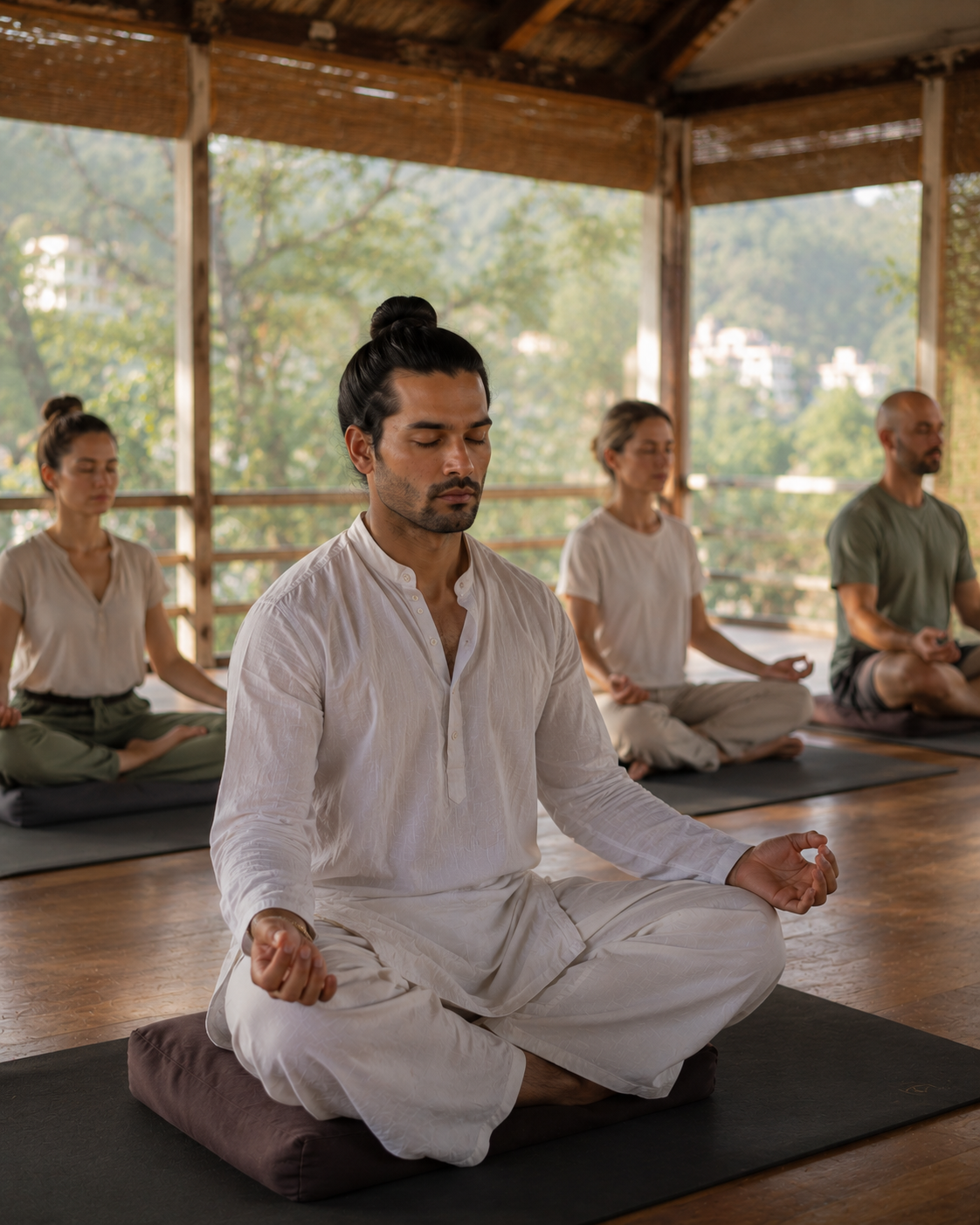
The single biggest misconception about meditation and what it actually involves
The most persistent misconception about meditation is that the goal is to stop thinking. It is not. The human mind produces thoughts continuously this is what minds do. No amount of practice stops it. What meditation develops is a different relationship to thought: the capacity to notice that a thought has arisen without being immediately captured by it, without following it into an associated chain of further thoughts, without being defined by it.
The actual practice of meditation regardless of technique involves: choosing an object of attention (the breath, a mantra, a sensation), placing attention on that object, noticing when attention has wandered away (to a thought, a sound, a feeling), and returning attention to the object. That is it. Repeated thousands of times, with patience and without self-criticism, this simple act produces a change in the quality of attention that accumulates over weeks and months into something that practitioners describe as transformative not dramatically, but in the most practical sense: the mind becomes quieter, responses become less reactive, and the ability to remain present in difficult circumstances increases.
Most people who attempt meditation without instruction find it frustrating, because they are either trying to stop thinking (impossible) or they are expecting a dramatic experience that does not come. Good instruction changes both the method and the expectation in ways that make practice immediately more workable.
Our meditation classes begin with these basics and build progressively. Students who have "tried meditation and found it doesn't work" routinely discover that the issue was not meditation but instruction or the lack of it.
The meditation techniques in our classes and what each one is for
Different techniques work better for different people and for different stages of practice. We teach several approaches because no single technique suits everyone.
Breath-centred awareness (Anapanasati)
The most fundamental and widely researched meditation technique. Attention is placed on the physical sensations of breathing the feeling of air at the nostrils, the rise and fall of the chest or belly, the rhythm of each cycle. When attention wanders, it is returned. This technique develops the foundation of meditative attention and is appropriate for all levels. It is the starting point for most students and can be practised throughout a lifetime without becoming simplistic depth in this technique is essentially unlimited.
Body scan (Vipassana / MBSR-derived)
Systematic movement of attention through different areas of the body typically from the crown of the head downward, or from the feet upward. The practice develops somatic awareness (the ability to sense the body from the inside), releases physical holding that awareness alone can address, and produces a distinctive quality of groundedness and presence. It is often the first technique that works well for people who find breath-only meditation difficult because it gives attention more to do.
Mantra meditation (Japa)
Repetition of a word or phrase silently or in a low voice as the object of meditation. Mantras used in our classes include Sanskrit mantras (So Hum, Om, Sat Nam), the classical ajapa japa of the breath, and in some cases secular phrases chosen for their quality of attention rather than their content. Mantra meditation works well for people who find that the breath alone is too subtle to hold attention the mental activity of repetition provides more of a hook for the mind than pure sensory observation. Research on mantra-based practices is substantial and consistently shows significant effects on stress markers and nervous system function.
Loving-kindness (Metta)
A systematic practice of directing goodwill first to oneself, then to loved ones, then to neutral people, then to difficult people, then to all beings. The phrases used vary by tradition, but the classic form involves repeating internally: "May you be well. May you be happy. May you be free from suffering." Metta practice is extensively researched and consistently shows effects on compassion, social connectedness, and reduction of self-critical thinking. It is one of the most practically transformative meditation forms when practised seriously.
Open awareness (Rigpa / Choiceless awareness)
A more advanced practice that begins after concentration has been developed through the previous techniques. Rather than placing attention on a specific object, the meditator rests in bare awareness itself aware of whatever arises (thoughts, sounds, sensations, emotions) without selecting, suppressing, or following any of it. This practice produces the quality of spacious presence described in many contemplative traditions. It is introduced in our classes after students have established some foundation in breath or mantra practice.
The specific, observable changes that develop through consistent meditation practice
These are based on both the research literature and the consistent reports of students who practise regularly. We do not claim meditation is a treatment for anything.
The gap between stimulus and response widens
One of the most consistently reported changes in meditators is a widening of the gap between a triggering event and their response to it. Where previously a challenging email, a confrontational conversation, or a traffic jam would produce an immediate reactive response, there develops gradually and almost imperceptibly a small pause. In that pause, the response becomes more chosen and less automatic. This is not emotional suppression. The emotion still arises. The practitioner simply has slightly more choice about what to do with it.
Self-critical thinking reduces in frequency and intensity
The practice of returning attention to the meditation object without criticism without judging oneself for having been distracted, without labelling the session as "bad" because thoughts arose trains a quality of self-regard that extends beyond meditation. Students who practise consistently for several months typically report a noticeable reduction in self-critical inner commentary, not because they have decided to think better of themselves, but because the habit of non-judgmental noticing has generalised into daily life.
The quality of sleep often improves
The relationship between meditation practice and sleep quality is one of the most consistent findings in the research literature on meditation. The mechanism appears to be a combination of reduced physiological arousal at bedtime (from the parasympathetic activation produced by regular practice), reduced cognitive rumination (the "mind racing" phenomenon that prevents sleep onset), and the development of a relaxation response that the body learns to access more readily. These effects are typically most noticeable in students who have been practising for six weeks or more.
The ability to concentrate in other contexts improves
Meditation is attention training. The specific skill being practised placing attention on an object, noticing when it has wandered, returning it is the same skill required for any demanding cognitive activity: studying, writing, complex problem-solving, sustained listening. Students who establish a consistent meditation practice typically notice improvements in their ability to concentrate at work or study within two to three months. This is not an incidental benefit it is a direct transfer of the trained capacity.
A realistic guide to starting a meditation practice
What you need before your first session
What you do not need
Ready to begin meditation?
Tell us your experience level and whether you prefer online or in-person. We will recommend the right starting point.
You have been taught that the goal is to stop thinking. It is not. The goal is to notice thinking and in that noticing, discover that you are not the same as your thoughts.
This is the most practically significant thing meditation produces. And it develops through practice, not through understanding it intellectually.
The students who consistently get the most from our meditation classes
People who have "tried meditation" without instruction
The single largest group of students who contact us about meditation classes are people who have attempted self-directed practice through apps, YouTube, or simply sitting and found it frustrating or ineffective. In almost all cases, the problem is not the person and not meditation. The problem is the absence of clear, direct instruction that explains what the practice actually involves, what to expect, and how to work with the specific difficulties that arise for each individual student.
Yoga practitioners wanting to deepen practice
Yoga and meditation are designed to work together the classical yoga tradition treats asana practice as preparation for meditation, not as a substitute for it. Students who have been practising yoga for years often reach a point where the physical practice is well-established and they feel a pull toward something quieter and more inward. Meditation provides that. Our yoga and meditation classes are coordinated so that students can practise both as a coherent, complementary whole.
Working professionals seeking a sustainable stress tool
Twenty minutes of daily meditation practice, sustained consistently, produces effects on the stress response, sleep quality, and cognitive function that are difficult to achieve through any other means in the same time investment. The challenge is not learning the technique it is establishing the habit. Our classes are specifically designed to support this habituation process, with practical guidance on making daily practice realistic within a working schedule and troubleshooting the specific difficulties that arise when the habit breaks down.
What students ask before their first meditation class
Yes. In fact, people who describe their minds as very busy often progress quickly in meditation, because they are already keenly aware of the mind's activity which is the first and most important thing meditation requires. The practice is not about having a quiet mind to begin with. It is about developing a different relationship to whatever the mind does. A busy mind gives you many more opportunities to practise noticing and returning which is where the training happens. The people who struggle most with meditation are often those who have very quiet, compliant minds and do not get as much practice in the fundamental return.
Most people notice something within the first two to four weeks of consistent daily practice typically a slight but perceptible change in how quickly they recognise stress when it arises, or a marginal improvement in their ability to pause before reacting. These early signs are subtle. More substantial changes changes that people around you might notice typically emerge after two to three months of daily practice. The research literature on meditation benefits generally requires at least eight weeks of consistent practice to show significant results. The most profound changes often occur somewhere between six months and two years. Consistency, not intensity, is what produces development.
No. The techniques we teach work through observable mechanisms attention, breath, repetition that do not require any particular worldview. Meditation has been studied extensively in secular scientific contexts and its effects on stress markers, brain structure, attention, and emotional regulation are well-documented regardless of the practitioner's spiritual orientation. The techniques originated in contemplative traditions with specific philosophical frameworks, and we engage honestly with that context. But whether you are drawn to the spiritual dimensions of the practice or whether you engage with it purely as a practical health tool, the practice produces the same effects.
Both work. The practical answer is: meditate when you will actually do it consistently. Consistency matters more than timing. That said, most meditation teachers recommend morning practice for two reasons: first, the mind tends to be less churned by the day's events in the morning; second, meditating before the rest of the day begins establishes it as a priority rather than something you fit in if time allows. Evening meditation is valuable for its effect on sleep and for processing the day, but there is more risk of tiredness interfering with the quality of attention. Many experienced practitioners meditate at both times. Start with once, do it consistently, and expand from there.
For learning meditation, online instruction is highly effective possibly more so than in-person for some students, because the home environment where you will actually practise is also where you learn. What matters in meditation instruction is the quality of explanation and the teacher's ability to address specific questions and difficulties as they arise. Both are fully achievable online. What in-person offers that online cannot is the quality of physical presence the shared silence of a group in the same room, and the subtle guidance that an experienced teacher provides through presence rather than words. For experienced practitioners, this matters. For students in the first year of practice, the difference is minimal. Our online meditation sessions are live, interactive, and conducted with full attention to each participant's questions and experience.
Practices that pair naturally with meditation
Explore All Programs & Services
Quickly select any service below to explore schedules, curriculum, and direct WhatsApp booking.
Learn to meditate with real instruction online or in Rishikesh.
Tell us where you are total beginner, experienced but without instruction, or returning after a gap. We will recommend the right entry point and format for you.