Yoga Style
Kundalini Yoga Energy, Awareness, and the Technology of Kriya
Kundalini yoga is unlike any other yoga style. Built around kriyas specific sets that combine breath, movement, mantra, mudra, and meditation it works with the energy and nervous system in ways that are direct, systematic, and distinct from physical yoga traditions. A serious practice for students who approach it seriously.
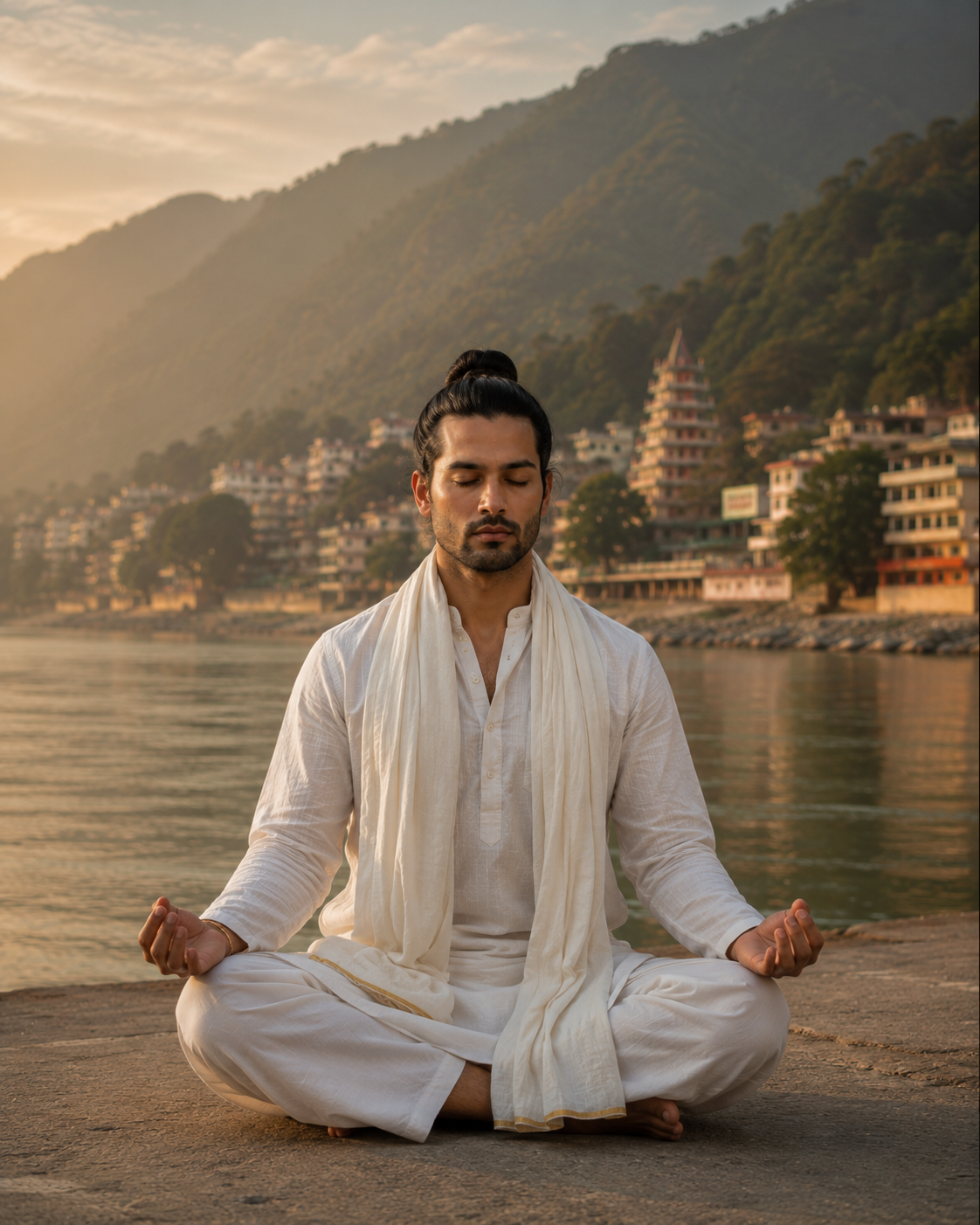
What Kundalini yoga is and what distinguishes it from every other approach
In classical yoga philosophy, Kundalini refers to a latent energy described as coiled like a serpent at the base of the spine (Muladhara chakra) which, through sustained and specific practices, rises through the energy centres of the body (chakras) toward the crown (Sahasrara), producing states of heightened awareness and, in the most advanced cases, transcendent experience. This is the metaphysical framework.
The Kundalini yoga practiced in most Western countries today was largely transmitted by Yogi Bhajan (1929-2004), who brought the practice from Punjab to the United States in 1969. He framed it as a "technology" rather than a religion a practical system for working with the nervous system, energy body, and mind. He deliberately made the practice accessible to lay practitioners rather than restricting it to monastic or initiatory contexts.
What distinguishes Kundalini yoga from every other physical yoga style is its use of kriyas complete practice sets that combine specific breath patterns, precise body positions, hand gestures (mudras), internal locks (bandhas), focused eye positions (drishti), and mantras into unified sequences that have defined purposes and effects. These are not improvised sequences. Each kriya is a specific technology, transmitted intact from teacher to student.
It is worth being direct about one thing: Kundalini yoga, as taught through the Yogi Bhajan lineage, has a specific aesthetic white clothing, head covering, Sikh-derived mantras, particular vocabulary that can be unfamiliar and even off-putting to students from secular backgrounds. At The Seventh Center, we teach the practices seriously, but we engage honestly with their cultural context. You do not need to adopt any particular framework, spiritual identity, or dress code to practise Kundalini yoga and receive its benefits.
What makes up a Kundalini yoga session and what each element does
Adi Mantra connecting to the lineage and to internal guidance
Every Kundalini class begins with three repetitions of the Adi Mantra: "Ong Namo Guru Dev Namo" ("I bow to the infinite creative energy; I bow to the divine wisdom within myself and all teachers"). This is chanted together before beginning any practice. It serves to centre the group, transition from ordinary activity to practice, and acknowledge the lineage of teachers through whom the practices were transmitted. Students who prefer not to understand it in spiritual terms can engage with it as a group breath and sound exercise that serves a genuine centering function.
Spinal series preparing the energy centres
A typical Kundalini warm-up includes spinal flex (Sat Kriya variant), cat-cow variations, and spinal rotation. These movements specifically target the spine and the energy flow along the spinal column, preparing the nervous system for the main kriya. The warm-up in Kundalini is not a generic body warm-up it is specifically designed to activate the channel (sushumna nadi) through which Kundalini energy is understood to rise.
The complete practice set specific technology for a defined purpose
The central element of the class. A kriya is practiced as a unit each exercise within it follows from the last, and the sequence is not modified or rearranged. Common kriyas include those for the nervous system (Kriya for Elevation, Kriya for Mental Clarity), the digestive system and navel centre (Sat Kriya), the electromagnetic field (Surya Kriya), or for releasing stress and emotional patterns. Each exercise within the kriya specifies: body position, breath pattern, drishti, mudra, and duration. A typical kriya takes 20 to 40 minutes.
Savasana with guided body awareness
Following the kriya, students lie in savasana for 5 to 11 minutes (timing is specific in Kundalini practice). The nervous system integrates the effects of the kriya during this period. In Kundalini, the relaxation is not optional the effects of the kriya are considered to consolidate during this period, and skipping it is understood to reduce what the practice produces. Students are sometimes guided through a systematic body awareness during the relaxation.
A specific technique often with mantra and mudra
Every Kundalini class ends with a meditation. Unlike generic mindfulness meditation, Kundalini meditations are specific techniques: each has a particular mudra, breath pattern, mantra (silent or audible), drishti, and duration. Common meditations include So Hum breath meditation, Kirtan Kriya (Sa Ta Na Ma), meditations for the nervous system, and various mantra repetition practices. The meditation typically runs 11 to 31 minutes, though classes may use shorter versions.
Long Sat Nam sealing the practice
The class closes with a long "Sat" (truth/reality) and short "Nam" (identity/name), chanted together. This serves to bring the energy of the practice back into a settled state before students re-enter daily activity. The Kundalini tradition treats the close of practice as carefully as the opening the transition out of an activated state is considered as important as the transition into practice.
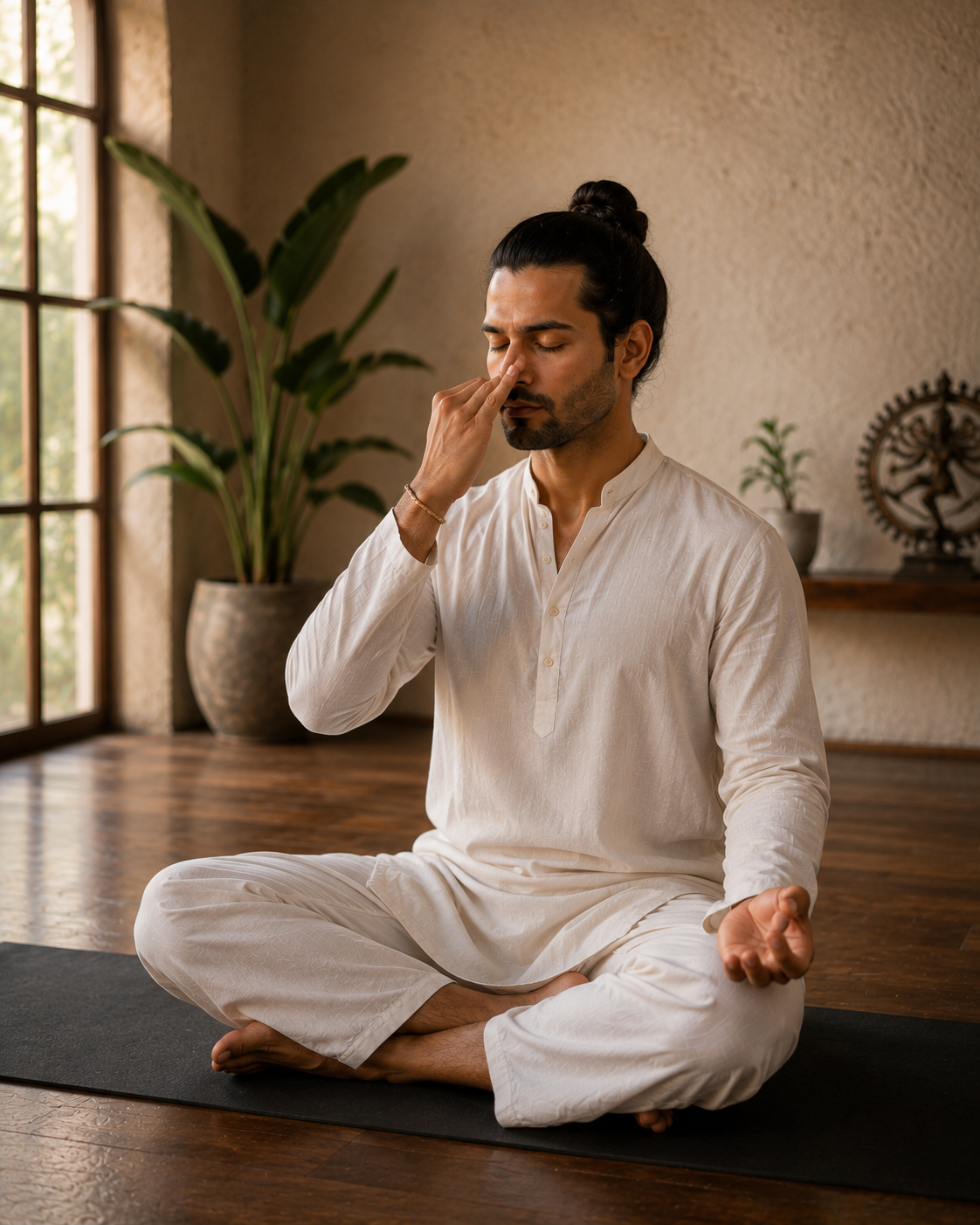
Breath and mantra in Kundalini yoga what they actually do
The breath practices
Kundalini yoga employs several specific pranayama techniques, each with distinct physiological effects. The most important is Breath of Fire (Agni Pran) a rapid, rhythmic diaphragmatic breath through the nose at approximately two cycles per second, with equal emphasis on the inhale and exhale. It generates significant internal heat, activates the sympathetic nervous system, strongly oxygenates the blood, and produces the characteristic energised state associated with Kundalini practice. It is taught progressively and has contraindications.
Long Deep Breathing (diaphragmatic breathing) is the complementary practice slow, full, from the belly through the chest which activates the parasympathetic nervous system and produces calmness, clarity, and emotional regulation. Many kriyas alternate between Breath of Fire and Long Deep Breathing, using the tension between activation and settling to produce specific effects.
The mantra practices
Mantra in Kundalini yoga is not prayer in a devotional sense it is understood as a sound technology. The specific sound currents of Sanskrit and Gurmukhi mantras are held to produce specific effects through vibration on the palate, which stimulates the hypothalamus; in the body's resonant cavities; and on the subtle energy body. Whether or not one accepts the metaphysical explanation, there is good practical evidence that rhythmic sound repetition produces specific neurological effects, and mantra practice has been studied as a meditation technique with its own research base.
Common mantras: Sat Nam ("Truth is my identity" the most fundamental Kundalini mantra); Waheguru ("Wonderful teacher" a mantra of wonder and devotion); Ra Ma Da Sa Sa Say So Hung (a healing mantra that activates the heart centre); Sa Ta Na Ma (the Panj Shabd, used in Kirtan Kriya said to represent the complete cycle of existence). Students need not understand or believe the translations to practise the mantras effectively.
Kundalini yoga is not a belief system. It is a set of practices that produce observable effects on the body, nervous system, and mind whether or not you have any particular view about their source.
Approach it as a technology, not a religion. Be curious. Be consistent. Let the practice demonstrate its own validity or not.
What students consistently report from regular Kundalini practice
These are descriptions of consistent student experiences. We make no medical claims and no promises about spiritual outcomes.
Significant nervous system effects
Students consistently report marked shifts in their nervous system state both during and after Kundalini practice. This includes both energising effects (after practices with Breath of Fire) and deeply settling effects (after practices with Long Deep Breathing and Shabd Guru mantra). Many students who struggle with anxiety find specific Kundalini kriyas produce changes in their baseline nervous system state that other approaches have not.
Emotional processing
Kundalini yoga students often report experiences during or after practice that involve emotional release sometimes unexpected. This is particularly associated with kriyas that work on the navel centre, the heart, and the upper energy centres. We do not sensationalise these experiences, but we also do not pretend they do not occur. A good teacher creates the conditions in which students can have these experiences safely, and holds the space with care when they do.
Changes in mental clarity
The specific breathwork practices of Kundalini yoga particularly Breath of Fire produce measurable changes in blood oxygenation and brain state that many students experience as increased mental clarity, improved focus, and a reduction in the mental fog associated with stress, poor sleep, and sedentary work. These effects are typically immediate and are one reason Kundalini often becomes a morning practice for students who discover it.
The experience of meditation made accessible
Many students who have struggled to meditate using breath-only or awareness-only techniques find that Kundalini's multi-layered approach mantra + mudra + breath + specific eye position gives the mind enough to hold that the ordinary thought-stream quiets naturally. The meditation components of Kundalini practice can function as a bridge into the broader landscape of contemplative practice for students who have not yet found a meditation technique that works for them.
Physical strength and endurance
This surprises some students who expect Kundalini to be a gentle spiritual practice. Many kriyas are physically demanding repetitive arm movements held for three to eleven minutes, seated body positions maintained through intense breath work, and leg and core exercises sustained over significant durations. Students who practise Kundalini regularly develop a specific kind of physical endurance that combines muscular holding capacity with breath and mental discipline.
A sense of working with something beyond the physical
This is the hardest to describe and the most consistent report from long-term Kundalini practitioners. A quality of working with energy, awareness, or presence that is distinct from physical exercise and from intellectual study. We describe this with care not as evidence of any specific metaphysical claim, but as an honest account of what students experience. Whether one interprets this experience in spiritual, neurological, or psychological terms is a matter of personal perspective. The experience itself is real.
Curious about Kundalini yoga?
It is a distinctive practice. Talk to us first we will answer your questions honestly before you commit to anything.
What students ask about Kundalini yoga
No. Kundalini yoga can be engaged with entirely as a practical technology a set of specific practices that produce observable effects on the nervous system, breath, and mind without any spiritual or religious framework. The mantras and language of the practice carry a tradition and a lineage, and we engage honestly with that context rather than pretending it does not exist. But adopting a particular worldview is not required to receive the practical benefits of the practice. Many secular-minded scientists, healthcare professionals, and atheists practise Kundalini yoga and find it valuable precisely for its practical, observable effects.
This is a genuinely complex question that deserves an honest answer rather than a convenient one. The classical description of Kundalini as a latent energy coiled at the base of the spine is a traditional model found in Tantra, Kashmir Shaivism, and various schools of yoga for describing something that experienced practitioners consistently encounter. Whether this represents a literal energy, a neurological phenomenon, a psychological process, or a metaphor for something else entirely is a matter of genuine debate and ongoing research. What is not debated is that specific Kundalini practices produce consistent and describable effects on physiology, neurological state, and subjective experience. We engage with both the traditional framework and the observable effects honestly, without asserting that one is the only valid interpretation.
Yes. Kundalini yoga has more specific contraindications than most yoga styles, largely due to its intensive breathwork. Breath of Fire is contraindicated for: pregnant women (due to the intense abdominal contraction); people with high blood pressure or heart conditions; people with a history of psychosis or certain mental health conditions (due to its strong neurological effects); and individuals with active ear or sinus infections. Specific kriyas may have additional considerations. We always ask about health history before teaching Kundalini practice and adapt accordingly. If you have any of the above conditions, please tell us there are always appropriate alternatives within the Kundalini system.
The primary difference is lineage and context. Kundalini yoga in Rishikesh is taught within a broader yoga tradition teachers who have studied here have typically also practised other classical systems and understand Kundalini in relation to the broader yoga philosophical framework. In many Western studios, Kundalini is taught in isolation, without much context for its relationship to classical yoga, to the Tantric traditions it emerged from, or to the broader question of how to integrate such a powerful practice safely over time. This does not make one context necessarily better, but the depth of contextual understanding available here tends to produce a more nuanced teaching approach.
Other practices at The Seventh Center
Explore All Programs & Services
Quickly select any service below to explore schedules, curriculum, and direct WhatsApp booking.
Curious about Kundalini? Let us talk through it before you begin.
Kundalini is a distinctive practice. We prefer an honest conversation first tell us what you are looking for and we will tell you whether Kundalini is the right approach.