Our Story
About The Seventh Center What We Are, Why We Exist, and How We Teach
A yoga and wellness school built around the belief that a well-taught practice is one of the most genuinely useful things a person can develop and that teaching it well requires the same seriousness from the teacher as learning it requires from the student.
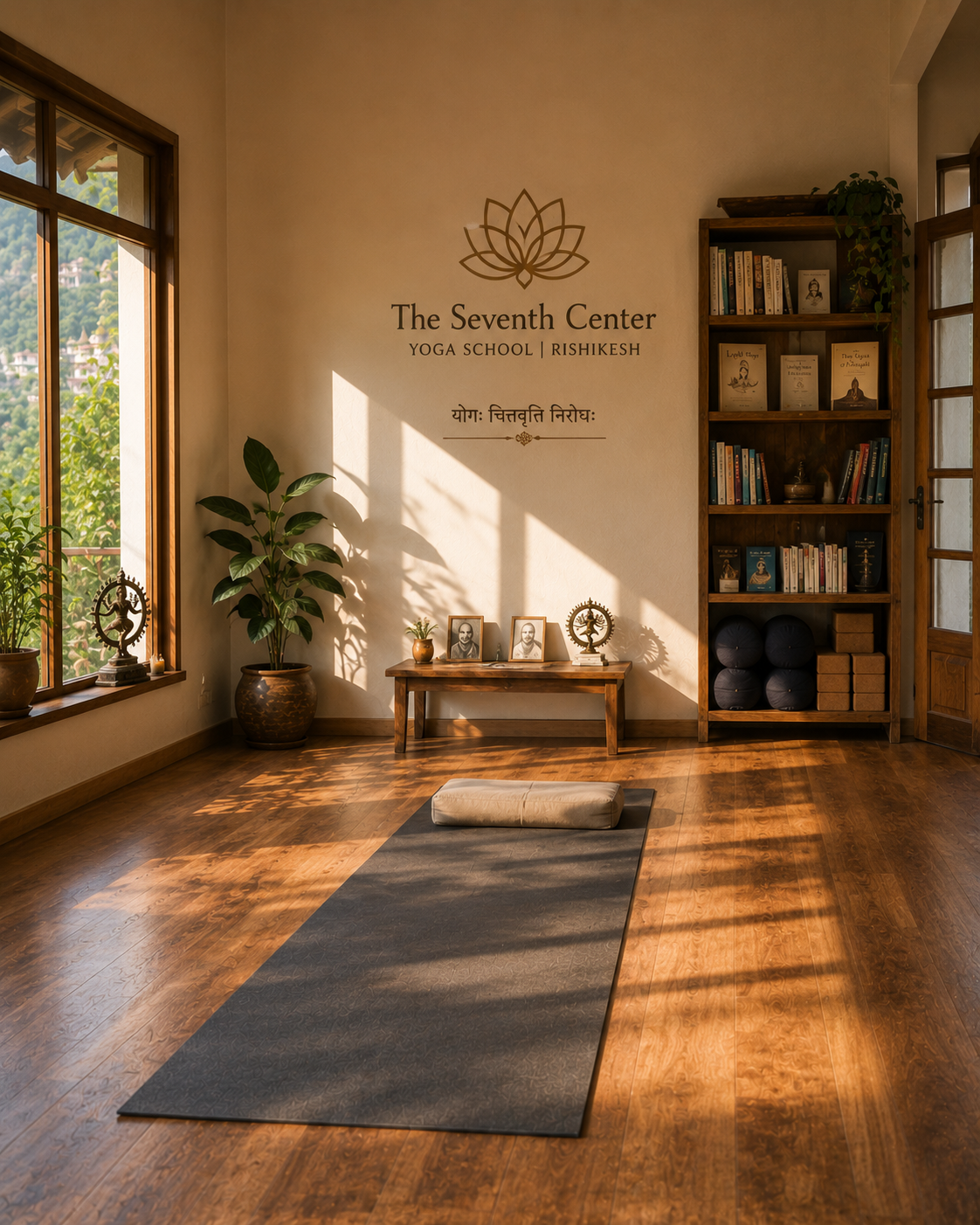
The Seventh Center a name chosen for what it points to, not for how it sounds
In classical yoga philosophy, the body is understood to contain a series of energy centres chakras arranged along the spinal axis. The first six are associated with progressively more refined qualities: earth, water, fire, air, space, and the development of discrimination and clarity. The seventh chakra Sahasrara, located at the crown represents something beyond these: pure awareness, the quality of consciousness that simply witnesses what arises without identification, without reaction, without the ordinary sense of a separate self looking at the world from inside a body.
We are not a school that trades in metaphysical claims. We chose this name because it points at something real not as a mystical state accessible only to advanced practitioners, but as a quality of attention and awareness that becomes gradually available through serious, sustained practice. The ability to observe one's own thoughts, emotions, and impulses from a degree of distance to have them without being entirely defined by them is not a spiritual achievement. It is a practical capacity that meditation, yoga, and pranayama develop, in their different ways, in most people who pursue them consistently and with good instruction.
That capacity call it awareness, clarity, equanimity, presence is what we are working toward with every student. It is available to beginners and experienced practitioners alike. It develops through practice and not through any other means. We have named our school after it because we consider it the most important thing yoga education can point toward, regardless of the entry point asana, meditation, pranayama, or sound healing through which any given student enters.
The school was founded in Rishikesh by teachers who had lived and studied in the city for years who wanted to create something that reflected the quality of genuine practice and genuine teaching that they had been fortunate enough to encounter, without the performance, the inflated claims, and the commercial pressure that have become common in yoga education worldwide.
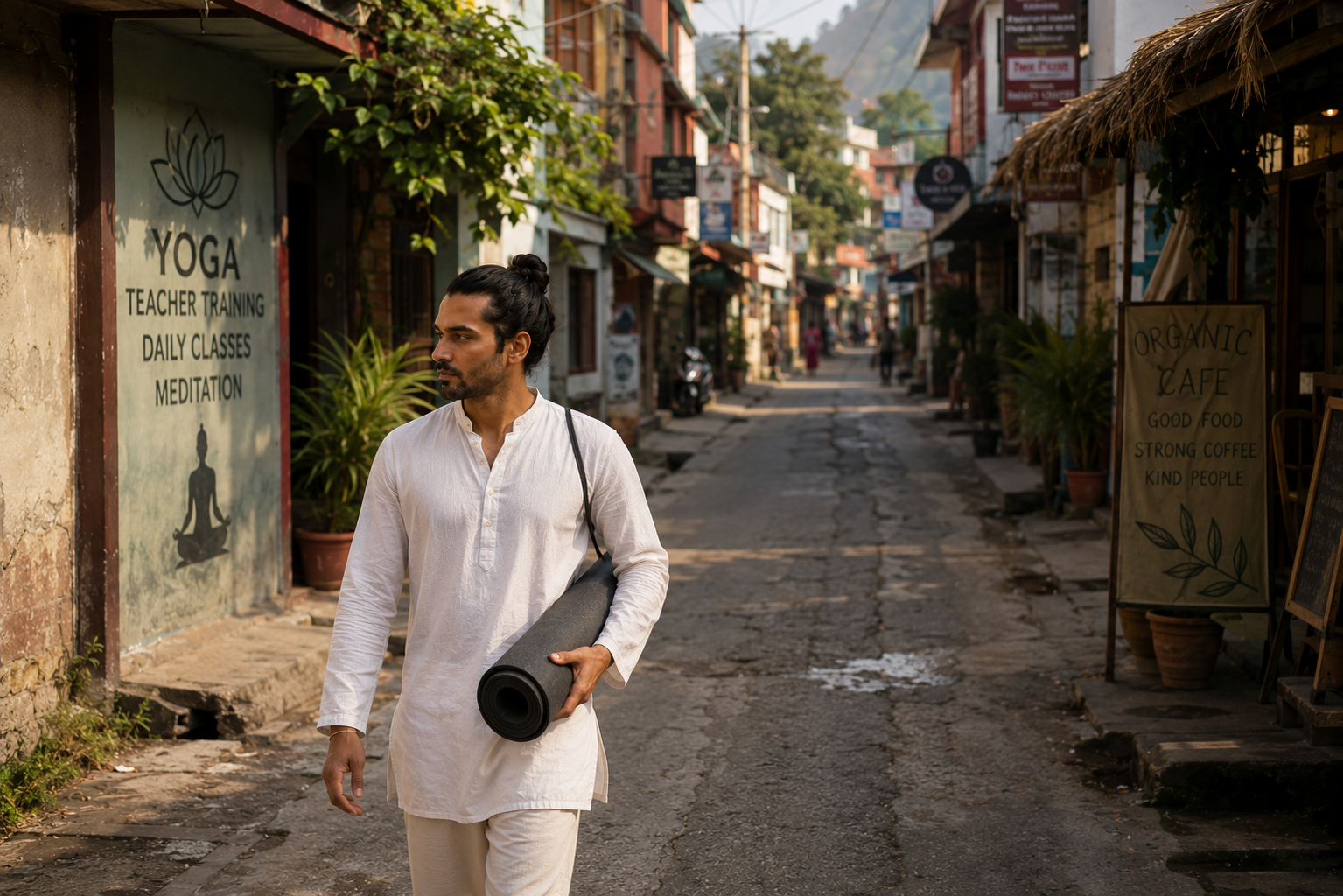
Rishikesh where we are based and what that means for the teaching
The Seventh Center is located in the Tapovan area of Laxman Jhula, Rishikesh, Uttarakhand, India at the northern end of the city, where the Ganges has just emerged from the Himalayan foothills and the character of the town is closer to the mountains than to the plains below. This is the area where the most dedicated yoga schools and serious practitioners have historically been concentrated, and where we continue to be based.
We did not choose Rishikesh as a branding decision. Our teachers lived here before the school existed. The practice that gave rise to the school grew in this environment. The decision to be located here is simply a reflection of where the teaching comes from which is the right reason to be anywhere.
What Rishikesh provides that our teachers believe genuinely matters: an unbroken community of serious practitioners spanning multiple generations, whose presence and continued practice creates an environment in which yoga is not a wellness product but a complete discipline a way of understanding and inhabiting the human experience. This environment shapes teaching in ways that are difficult to articulate and, for many visiting students, quite striking to encounter for the first time.
Tapovan, Laxman Jhula our centre
Walking distance from the Ganges. Close to Rishikesh's historic yoga district. Year-round programs for visiting students from around the world.
Address
Tapovan, Laxman Jhula, Rishikesh, Uttarakhand 249192
Hours
Classes from 6:00 AM through 7:00 PM daily
How we think about teaching yoga and why it matters that we think about it at all
Foundation before complexity
We teach alignment, breath awareness, and safe movement before introducing complexity. The physical practices of yoga like any physical discipline build on foundational patterns. A student who understands Tadasana (Mountain Pose) deeply will navigate every subsequent standing posture more safely and more productively than one who has been introduced to the entire Hatha curriculum in a month. We are patient about this. We have seen what it produces, and we believe it is worth the patience.
Small groups as a non-negotiable principle
Group size is the most important variable in whether teaching actually happens or whether demonstration happens. We maintain small group sizes in all our classes online and in-person because we believe a teacher who cannot see and respond to every student in the room is doing something other than teaching. We hold this principle even when it means turning students away or opening additional sessions. There is no way around it: individual attention is what makes yoga instruction valuable.
Explanation, not just instruction
We explain why postures are structured as they are, not just what shape to make. The anatomical basis for an alignment cue, the physiological effect of a breath technique, the philosophical context of a practice these are not optional additions for advanced students. They are what transforms a physical practice into a study, and a student who repeats a posture without understanding into one who is genuinely learning. This requires more time per posture. It produces more value per session.
Honesty about what yoga is and what it is not
We do not make medical claims. We do not promise transformation. We do not represent yoga as a solution to everything or appropriate for every person in every situation. We are direct about what practices involve, what they require from the student, and when a particular approach might not be right for someone. We believe this honesty is the foundation of the trust that makes a genuine teaching relationship possible and we believe genuine teaching relationships are the only kind worth having.
Teachers who practise
Every teacher at The Seventh Center maintains their own serious daily practice. This is not something we impose as a policy it is a quality we select for, because it reflects the kind of teacher we want to work with. A teacher who has not practised sincerely and consistently for years cannot teach yoga well. They can teach the forms. They cannot teach from inside the experience that makes the forms meaningful. The distinction is apparent to students after a single class.
The things we will not do and why each one matters
We do not make medical claims
Yoga can contribute to wellbeing in meaningful ways. It is not a medical treatment and should never be represented as one. We describe what practices reliably produce based on experience and research, and we actively redirect students to appropriate medical professionals when health concerns arise. The distinction between "yoga may support your wellbeing" and "yoga will treat your condition" is not a technicality it is a fundamental honesty about what yoga is.
We do not manufacture urgency
There are no limited-time offers, countdown timers, or pressure tactics at The Seventh Center. The right time to join a program is when you are ready, when it fits your life, and when the program genuinely meets your needs. We would rather a student take three months to decide and then commit fully than rush a decision they later regret. Take the time you need.
We do not use fake testimonials or inflated numbers
The student experiences shared on our website reflect genuine accounts. We do not manufacture social proof, use stock photography as "student photos", or attribute quotes to invented people. The credibility of a yoga school should rest on the quality of its teaching, not on the convincingness of its marketing. We let the practice demonstrate its own validity or not, for a particular student at a particular time.
We do not claim unverified certifications
We do not list awards, certifications, or accreditations that we have not earned from legitimate organisations. We do not describe our programs as "internationally recognised" unless we can be specific about what that means. The value of our teaching is in what students experience and develop not in the number of logos we can display on a website.
We do not teach yoga only as physical fitness
Yoga done only as exercise produces exercise results. Taught as a complete discipline integrating asana, breath, and meditative attention it produces something qualitatively different. We maintain this distinction in our teaching because we believe it is the most significant thing that distinguishes a yoga school from a fitness studio, and because the classical tradition whose practices we teach insists on it with good reason.
We do not tell you yoga is easy
A genuine yoga practice is demanding physically, mentally, and in the consistency it requires. We support students through that demand honestly, which means naming it clearly, celebrating genuine progress, and distinguishing between the productive difficulty that produces development and the counterproductive effort that produces injury or burnout. Both are real. The distinction is important.
We are not trying to be the largest yoga school in Rishikesh. We are trying to be a yoga school where the teaching is genuinely good and where that quality is maintained regardless of how many students come or go.
Explore All Programs & Services
Quickly select any service below to explore schedules, curriculum, and direct WhatsApp booking.
If this sounds like what you are looking for, let us talk.
Reach out on WhatsApp or by phone. Tell us where you are in your practice and what you are looking for. We will be direct with you about whether we are a good fit.