Our Philosophy
Why Students Choose The Seventh Center An Honest Answer
We are not the only yoga school in Rishikesh. We are not trying to be everything to everyone. Here is a direct, specific account of what we offer, how we work, and where the differences between us and other schools actually lie without the marketing language.
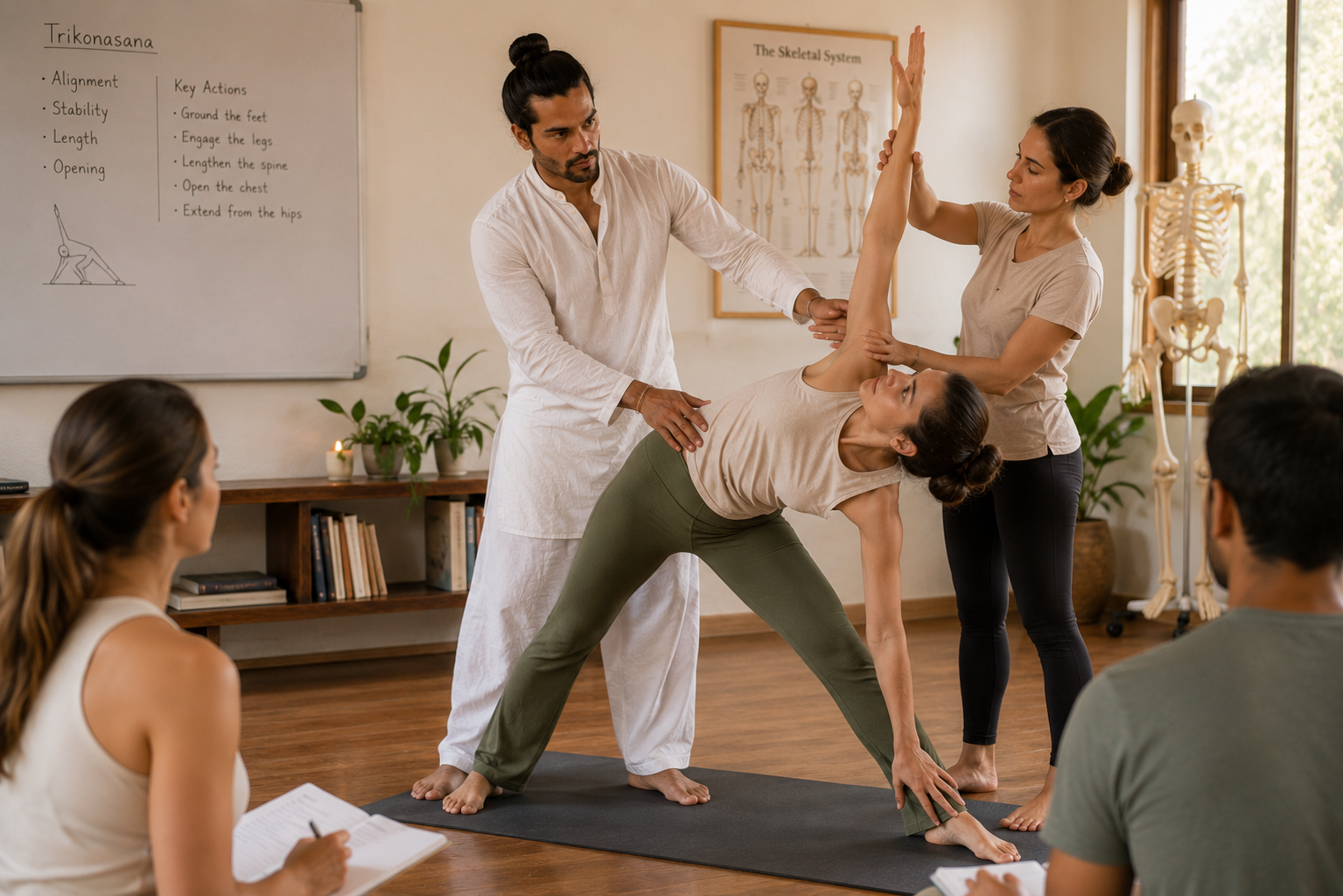
Teaching is not the same as demonstrating and the difference matters enormously
In many yoga classes, the teacher demonstrates the practice and the students follow. This works it produces familiarity with postures and develops a basic practice. But it has a structural ceiling. A teacher who is primarily demonstrating cannot observe and respond to the individual students in the room with the specificity that produces genuine individual development.
What distinguishes teaching from demonstration is the teacher's continuous observation of every student, the willingness to interrupt their own verbal instruction to address what they see, and the knowledge to know what they are looking at when they see it. This requires: adequate time for each student (determined by group size), teachers who have practised the discipline seriously for long enough to have genuine expertise, and a teaching ethos that prioritises student development over class atmosphere or teacher performance.
Our small group sizes maintained deliberately across all programs and formats are the structural condition that makes this possible. We do not inflate numbers. When a class is full, it is full. Additional sessions are opened rather than group sizes stretched.
The quality of instruction that results from these conditions is the primary reason students return, refer others, and report that practice with us changed their experience of yoga in ways that years of studio attendance had not.
Why being based in Rishikesh genuinely matters and what it does not mean
What it does mean
Our teachers have lived and practised in Rishikesh for years not relocated there for commercial reasons, but because they were drawn to the teaching environment and the community of serious practitioners the city concentrates. The quality of yoga education available here, from the teachers and traditions that have been present for generations, shapes the knowledge our teachers carry and the standards against which they measure their own instruction.
For visiting students, the environment itself contributes something. The daily rhythm of a city where contemplative practice is cultural rather than commercial, the proximity to the Ganges and the Himalayas, the early mornings when practice begins before the city is fully awake these are not decorative. They are reported, consistently and without prompting, as integral to the retreat experience by students who have practised yoga elsewhere for years.
What it does not mean
Being in Rishikesh does not automatically produce good yoga teaching. There are many schools in Rishikesh, and quality varies significantly. A poor teacher in a beautiful place is still a poor teacher. The city provides a context and a community. Whether that context produces genuine learning depends entirely on who is teaching and how they approach it.
Nor does being in Rishikesh mean our programs are only for students who can travel to India. Our online programs are taught by the same teachers with the same standards. The location of our centre shapes who our teachers are and how they learned but it does not limit who we can teach or where.
We are not the right school for everyone. We are the right school for students who want genuine teaching, who are willing to work seriously, and who value honesty over reassurance.
That is a smaller group than we would sometimes like. It is the group we are designed for, and we would rather serve them well than everyone adequately.
The specific things we refuse to do and why each one matters to the quality of what we offer
We do not run large classes
Not because we cannot fill them, but because large classes cannot be taught well. A group of twenty-five students in a yoga class is not a class it is a workshop. The individual attention that distinguishes teaching from demonstration requires group sizes that make observation and response possible. We hold this principle consistently, even when it means turning students away.
We do not hire teachers for their social following
We hire teachers based on the quality and depth of their practice and their ability to teach not based on how many Instagram followers they have or how visually impressive their practice looks from outside. The most photogenic yoga practice is not necessarily the most knowledgeable yoga practice, and a teacher's public profile is a very poor indicator of their teaching quality.
We do not make medical claims
We describe what yoga practices consistently produce in honest, specific terms without claiming therapeutic or curative effects. We actively redirect students to appropriate medical professionals when their needs fall outside what yoga education can address. This boundary is not a limitation it is a condition of the trust that genuine teaching requires.
We do not pressure students
No sales calls, no package upgrades, no countdown timers, no artificial urgency. The right time to join is when you are ready and the program genuinely serves your needs. We would rather a student take their time and commit fully than rush a decision. If after speaking with us you decide another school is better suited to what you need, we will tell you so directly rather than trying to keep you.
We do not exaggerate our credentials
We do not claim awards, accreditations, or partnerships that do not exist. We do not describe our programs as "world-renowned" without basis. The credibility of our school rests on what students experience in our classes which we believe is the only form of credibility that means anything. Everything else is marketing.
We do not teach yoga only as fitness
Yoga taught only as physical exercise produces physical exercise results which have value, but are not distinctive. The classical yoga tradition integrates asana with pranayama and meditation, and treats the body as one system in a broader understanding of human functioning. We maintain this integration because we believe it is why yoga produces the quality of change that purely physical practice does not.
An honest guide to whether The Seventh Center is a good match
A good fit if you...
Might not be right if you...
Explore All Programs & Services
Quickly select any service below to explore schedules, curriculum, and direct WhatsApp booking.
If this sounds like what you are looking for, reach out.
We will be direct with you about whether our programs are right for what you need. If they are not, we will say so and if we can point you somewhere more suitable, we will do that too.